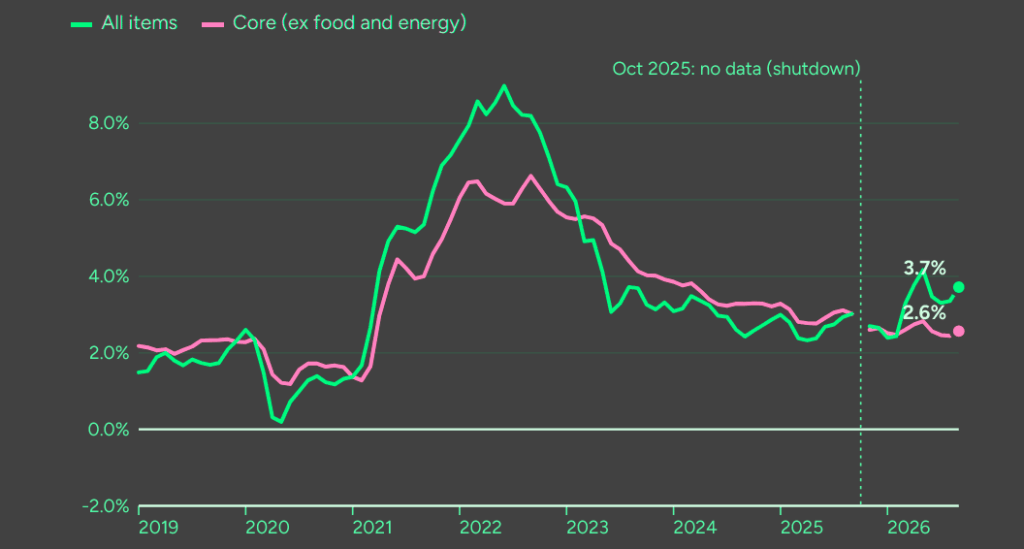
- US annual inflation accelerated to 3.7% in September 2026 from 3.4% in August, exceeding economists’ expectations of 3.6%, while core inflation rose to 2.6%.
- Gasoline prices surged 9.1% during September and 34.2% year over year, accounting for more than half the monthly increase in consumer prices amid disruptions linked to the US-Iran war.
- The inflation report complicates the Federal Reserve’s interest rate outlook after its September rate hike, with policymakers weighing persistent price pressures against the economic effects of higher borrowing costs.
US consumer price inflation accelerated to an annual rate of 3.7% in September 2026, driven by a sharp increase in gasoline prices and renewed pressure on housing and other consumer costs, reinforcing expectations that the Federal Reserve may need to raise interest rates again.
The Consumer Price Index (CPI), which measures changes in the prices of goods and services across the US economy, increased 0.6% on a seasonally adjusted monthly basis, according to figures released by the Bureau of Labor Statistics on October 14.
Annual inflation rose from 3.4% in August to 3.7% in September, exceeding the 3.6% forecast from economists surveyed by Dow Jones. The monthly increase matched expectations and followed a 0.4% rise in August.
Underlying inflation also strengthened. Core CPI, which excludes volatile food and energy prices, increased 0.3% from August and 2.6% over the previous 12 months. Economists had expected increases of 0.2% and 2.5%, respectively.
The annual core inflation rate accelerated from 2.4% in August, although the monthly increase was unchanged at 0.3%.
The figures indicate that inflationary pressures extend beyond energy markets, even as fuel costs remain the principal contributor to the latest increase in consumer prices.
Consumer price index (CPI)
- Energy prices rose 5.2% during September, following a 2.1% increase in August, as the continuing conflict involving the United States, Israel and Iran disrupted global energy supplies.
- Gasoline prices jumped 9.1% during the month, accelerating from a 3.9% increase in August. According to the Bureau of Labor Statistics, gasoline accounted for more than half of September’s overall monthly increase in consumer prices, compared with more than one-third in August.
The annual increase in gasoline prices reached 34.2%, while fuel oil prices climbed 74.2% over the same period.
The rise in energy costs has been closely associated with the war that began following US and Israeli strikes against Iran in late February. Continued disruptions to international energy supplies have increased the cost of transportation and fuel for American households and businesses.
- Food prices provided some relief during September, remaining unchanged after a 0.1% increase in August. Over the preceding 12 months, food prices rose 2.5%.
- Housing costs continued to increase. The shelter component of CPI, one of the index’s largest categories, advanced 0.4% during September, compared with 0.3% in August.
- Used car and truck prices increased 0.7% during the month, adding to price pressures outside the energy sector.
The combination of higher fuel prices and persistent increases in other consumer categories presents a challenge for the Federal Reserve, which has been attempting to bring inflation sustainably toward its 2% target.
Inflation measured by CPI has remained above 2% since March 2021. Although price growth had begun to moderate in early 2026, inflation accelerated after the outbreak of the Middle East conflict.
Annual inflation subsequently eased over several months before rising again in September.
The latest figures also demonstrate how prolonged disruptions to energy supplies can complicate monetary policy. Central banks generally treat temporary increases in commodity prices differently from persistent inflation driven by domestic demand.
Energy supply shocks are often expected to fade without requiring a substantial monetary policy response. Federal Reserve officials are nevertheless concerned that an extended conflict could allow higher fuel costs to spread through the economy, increasing business operating expenses and influencing household and corporate inflation expectations.
The measures were intended to address supply pressures as higher diesel costs threatened to increase the prices of goods transported across the United States.
Financial markets reacted to the September inflation report with a decline in US stock index futures and a sharp increase in Treasury yields.
The market movements reflected renewed concerns that persistent inflation could require additional Federal Reserve tightening, raising financing costs for businesses and consumers.
The Federal Reserve raised its benchmark interest rate in September for the first time in more than three years, approving a 25-basis-point increase that brought the federal funds target range to 3.75%-4%.
Before the latest inflation figures, financial markets generally expected the central bank to leave rates unchanged at its October meeting and approve another increase in December.
Initial federal funds futures trading showed little immediate reaction to the CPI release, despite the movements in equity futures and Treasury yields.
Market pricing had also suggested the possibility of at least two additional interest rate increases during 2027.
Federal Reserve policymakers remain divided over the urgency of further tightening, particularly as higher market interest rates may already be restraining economic activity.
Cleveland Federal Reserve President Beth Hammack warned in an October 12 speech that inflation pressures were not confined to energy markets.
She identified tariffs, investment associated with artificial intelligence and rising services prices as additional factors contributing to persistent inflation.
Her assessment suggests that policymakers may need to consider a wider range of price pressures when determining whether higher interest rates are necessary.
Federal Reserve Governor Christopher Waller offered a more cautious assessment of the need for an immediate rate increase.
Speaking to Bloomberg, Waller said higher Treasury yields were already contributing to tighter financial conditions and helping restrain economic activity.
That effect could reduce the urgency of another interest rate increase in October, even as inflation remains above the central bank’s objective.
New York Federal Reserve President John Williams also indicated that one additional rate increase may be warranted before the end of 2026.
The differing assessments illustrate the challenge facing policymakers as they determine whether the latest inflation increase primarily reflects external energy supply disruptions or more persistent domestic price pressures.
Further tightening could help contain inflation expectations and reduce demand, but higher interest rates would also add pressure to borrowing costs across the economy.
The September report suggests that inflation risks have become more difficult to assess because energy prices and underlying consumer costs are increasing simultaneously.
For consumers, higher gasoline and diesel prices are creating additional expenses at a time when housing costs continue to increase and food prices remain above their year-earlier levels.
The report also comes as the Federal Reserve evaluates whether the cumulative effects of previous monetary policy decisions and higher Treasury yields are sufficient to limit further price increases.
Federal Reserve officials examine CPI alongside employment figures, financial conditions and other economic indicators. Their preferred inflation measure for monetary policy is the Commerce Department’s personal consumption expenditures (PCE) price index, which differs from CPI in its composition and weighting.
The September PCE inflation report is scheduled for release later in October and will provide another assessment of underlying price developments before policymakers determine their next interest rate decision.