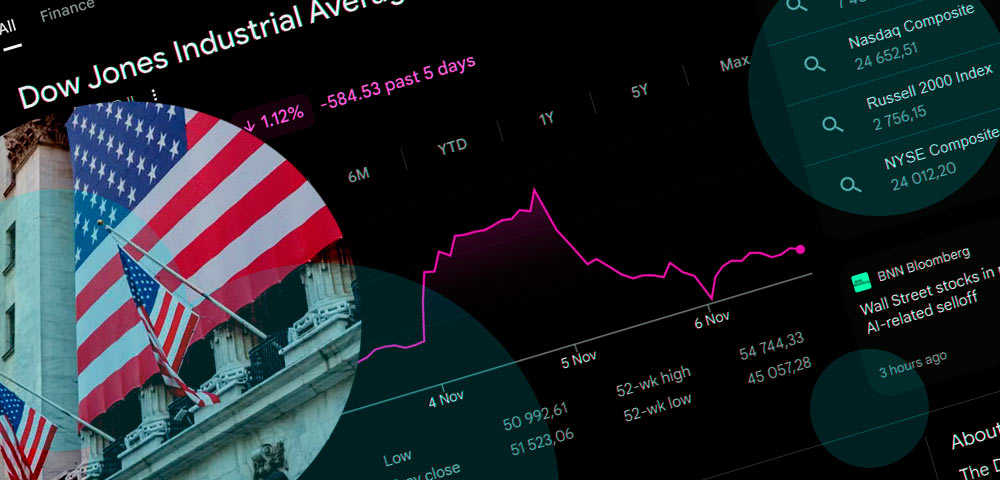
The Dow Jones Industrial Average remained under pressure on November 6, 2026, despite a recovery in technology stocks following Thursday’s $3 tn Wall Street selloff.
Stronger US employment data and expectations of further Federal Reserve interest-rate increases limited buying across industrial, financial and consumer stocks.
- The Dow Jones Industrial Average traded near 51,462 on November 6, down 0.12%, after Thursday’s 1,833-point plunge. Unlike the Nasdaq, the Dow struggled to recover as financial and industrial stocks remained under pressure.
- US employers added 165,000 jobs in October, exceeding forecasts, while unemployment fell to 4.1%. Strong labor data increased expectations of a December Federal Reserve rate hike, with the 10-year Treasury yield approaching 4.85%.
- Morgan Stanley sees signs that the market correction is nearing its end, while UBS and Standard Chartered remain cautiously constructive. Investment banks expect earnings growth to support a recovery, although higher borrowing costs and geopolitical risks could limit Dow Jones gains.
The Dow traded at 51,462.06 points, down 61 points, or 0.12%, at 2:25 p.m. ET. Meanwhile, the S&P 500 and Nasdaq Composite advanced as semiconductor shares recovered from the previous session’s losses.
On November 5, the Dow plunged 1,833.06 points, or 3.44%, to 51,523.06. The S&P 500 lost 4.36%, while the Nasdaq Composite dropped 5.52% and entered correction territory.
Why is the Dow Jones struggling to recover?
Unlike the technology-heavy Nasdaq, the Dow has substantial exposure to industrial companies, financial institutions and healthcare businesses. Its weaker performance on Friday indicated that the recovery was concentrated in technology rather than extending across the broader market.
Thursday’s selling affected major Dow components, including Caterpillar, JPMorgan Chase, UnitedHealth and 3M. Investors reduced exposure to economically sensitive companies as concerns about corporate financing costs spread beyond artificial intelligence.
The October employment report added another complication.
US nonfarm payrolls increased by 165,000, substantially exceeding expectations of approximately 65,000. Unemployment declined to 4.1%, while average hourly earnings rose 0.4% during the month and 3.1% from a year earlier.
The stronger labor market reduced expectations of monetary easing. Interest-rate futures indicated approximately a 78% probability of a Federal Reserve rate increase in December, compared with around 70% before the report.
The 10-year Treasury yield approached 4.85%, reinforcing concerns about borrowing costs and equity valuations.
Investment banks see opportunities but warn about interest rates
Morgan Stanley’s latest equity outlook suggests the US market correction may be approaching its final stages. The bank expects improving earnings and the removal of election uncertainty to support a potential year-end recovery.
Its strategists favor high-quality cyclical companies whose valuations have declined, particularly businesses capable of maintaining earnings growth despite tighter financial conditions.
Morgan Stanley Investment Management also expects financial stocks and previously depressed growth companies to participate in a possible recovery. However, higher interest rates remain the main obstacle to rising equity valuations.
UBS maintains a constructive outlook on US equities but expects further monetary tightening. The bank considers corporate earnings, inflation and borrowing costs more important for market performance than the composition of Congress. Its latest projections indicate that the Federal Reserve could raise rates by 25 basis points in December and again in March.
Standard Chartered’s November 6 market assessment identifies increasing signs that the equity selloff is approaching a bottom, particularly after the VIX volatility index exceeded 25.
The bank expects political gridlock to constrain additional tariffs and fiscal expansion, while a potential reduction in geopolitical tensions could ease oil prices and inflation expectations.
Nevertheless, its strategists remain cautious about the pace of recovery and favor a balanced approach to market risk.
Dow Jones outlook: Earnings growth versus higher bond yields
The outlook for the Dow depends increasingly on whether corporate earnings can offset higher interest rates.
Industrial companies could benefit from resilient manufacturing activity and infrastructure investment. October factory orders increased 1.8%, while the Logistics Managers’ Index climbed to 70.7, indicating continued demand across transportation and distribution networks.
Financial institutions face a more complicated environment. Higher interest rates can support lending margins, but elevated borrowing costs may weaken credit demand and increase pressure on borrowers.
Healthcare and consumer stocks could benefit from investors seeking earnings stability, although the October rotation into defensive sectors has already lifted some valuations.
The midterm election results introduce additional policy uncertainty. Democratic control of Congress could limit further tariff increases and encourage negotiations over the Iran conflict. However, the Republican administration retains significant authority over trade and foreign policy.
Brent crude traded around $98 per barrel on Friday, while West Texas Intermediate remained near $90.
Lower energy prices would support industrial profit margins and consumer spending, but renewed Middle East tensions could reverse that benefit.
Dow Jones forecast for November 2026
The Dow’s immediate outlook remains cautious following Thursday’s sharp decline. Friday’s relative stability suggests selling pressure has moderated, but the index has not yet demonstrated the same recovery momentum as the Nasdaq.
Investment-bank assessments point to two competing influences.
Improving corporate earnings, resilient employment and the potential for reduced political uncertainty support the longer-term outlook. Against those factors, higher Treasury yields and the prospect of additional Federal Reserve tightening could restrict near-term gains.
The 51,500-point area is an immediate reference level after Thursday’s close. A sustained recovery above that level would indicate improving demand, although a stronger advance would require broader participation from financial and industrial stocks.
Further weakness below 51,000 would suggest that Thursday’s selloff continues to influence market positioning.
For November, the Dow’s direction will depend less on the recovery in semiconductor stocks and more on industrial earnings, bank valuations, Treasury yields and the Federal Reserve’s December policy outlook.