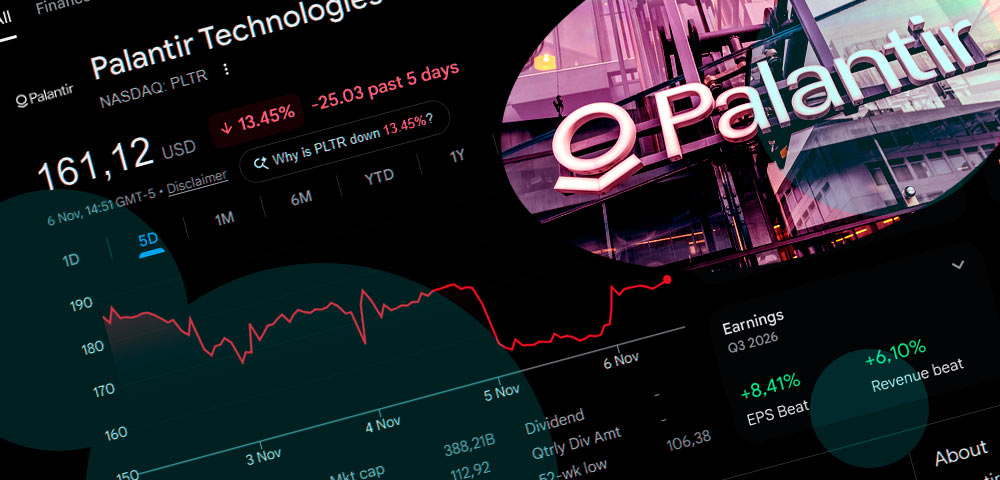
Palantir Technologies (NASDAQ: PLTR) shares rebounded on November 6, 2026, after eight consecutive losing sessions, as investors reassessed the company’s record earnings against slowing contract bookings, elevated valuations and uncertainty over US government spending.
PLTR traded at $160.95, up 3.84%, at 2:41 p.m. ET. The recovery followed a 9.73% decline on Thursday, when the stock lost approximately $40 bn in market capitalization amid a broader selloff in artificial intelligence companies.
- Palantir shares rebounded 3.84% to $160.95 on November 6 after falling 9.73% on Thursday. The stock remains approximately 24% below its October peak amid concerns over valuation and slowing contract bookings.
- Palantir reported record quarterly revenue of $2.313 bn, up 96%, while US commercial revenue surged 148% to $984 mn. However, total contract value grew just 6%, raising concerns about future revenue growth despite stronger earnings and upgraded guidance.
- Wall Street remains divided on PLTR’s outlook. Goldman Sachs targets $235, Bank of America $255, Barclays $273 and Morgan Stanley $233, while RBC Capital Markets forecasts $130. The average analyst target of approximately $218 implies 35% upside from November 6 levels.
Palantir has fallen roughly 24% from its October 9 peak, despite reporting its fastest quarterly revenue growth since becoming a public company.
Palantir reports 96% revenue growth but contract bookings disappoint
Palantir’s third-quarter revenue increased 96% year over year to $2.313 bn, exceeding Wall Street’s estimate of approximately $2.18 bn. Adjusted earnings reached $0.44 per share, compared with expectations of $0.41.
US commercial revenue surged 148% to $984 mn, surpassing US government revenue of $953 mn for the first time. Total government revenue, including international contracts, reached $1.146 bn.
The company raised its full-year 2026 revenue forecast to $8.530-8.534 bn and expects fourth-quarter revenue of $2.649-2.653 bn.
Profitability also improved. Adjusted operating income reached $1.427 bn, representing a 62% margin, while adjusted free cash flow totaled $1.216 bn. However, forward contract indicators raised concerns.
Total contract value increased just 6% year over year to $2.918 bn, compared with 49% growth in the previous quarter. US commercial contract value grew 11%, sharply below the 153% increase reported in the second quarter.
Remaining performance obligations reached $4.9 bn but were unchanged sequentially.
Management attributed part of the slowdown to shorter contract durations, particularly in emerging sovereign AI projects. Investors are now assessing whether those contracts will translate into larger, longer-term commitments.
Palantir stock price targets: Goldman Sachs, Morgan Stanley and Barclays
Investment-bank forecasts remain widely divided despite the recent selloff.
- Goldman Sachs maintained its Buy rating and increased its Palantir price target to $235 from $230 following the third-quarter results.
- Bank of America reiterated its Buy recommendation with a $255 target, reflecting confidence in commercial AI adoption and the company’s earnings trajectory.
- Citigroup raised its target to $265, while Barclays increased its forecast from $265 to $273.
- Morgan Stanley lifted its target from $205 to $233 but maintained an Equal-Weight rating, indicating a more cautious assessment of valuation.
- RBC Capital Markets remains bearish, with an Underperform rating and a $130 target. Jefferies has an even lower $80 forecast.
The average 12-month analyst price target stands near $218, approximately 35% above Palantir’s November 6 trading price.
The substantial difference between bullish and bearish forecasts reflects disagreement over how much future growth is already included in the company’s valuation.
Why are investors selling Palantir despite record earnings?
Palantir’s revenue growth remains exceptional among large enterprise software companies. However, the stock entered November trading at approximately 80 times forward earnings and more than 250 times trailing earnings.
At those multiples, investors expect rapid revenue expansion, sustained operating leverage and continued growth in contract commitments.
Thursday’s decline was part of a wider reduction in exposure to highly valued AI software companies. CrowdStrike, Okta, Palo Alto Networks and Rubrik also suffered sharp losses.
The selloff followed Democratic victories in the US midterm elections, raising questions about future AI regulation and government procurement priorities.
Government customers still account for approximately half of Palantir’s revenue. Changes in federal defense and technology spending could affect the timing and size of future contracts.
Nevertheless, commercial adoption continues expanding. Palantir announced a new enterprise partnership with AmeriLife on November 5 to deploy its Foundry and Artificial Intelligence Platform across insurance and retirement distribution operations.
Palantir stock forecast: Technical outlook for November
Palantir’s November 6 recovery has improved short-term momentum but has not reversed the broader correction.
The stock recently tested its 200-day moving average near $154, an important technical reference after several weeks of selling.
A sustained move above $165-170 would indicate stronger buying interest. The 50-day moving average, near $186, represents a more substantial potential resistance area.
Failure to maintain support around $154 could expose the stock to renewed selling pressure.
The near-term outlook depends on whether investors regain confidence in Palantir’s contract pipeline.
The company’s 165% net dollar retention rate indicates strong spending growth among existing customers. However, slower new contract bookings could eventually affect revenue growth if shorter agreements are not renewed or expanded.
Investment-bank forecasts remain predominantly positive, supported by accelerating commercial revenue and high operating margins. The principal risk is valuation rather than an immediate deterioration in reported earnings.
Palantir’s next quarterly results will be particularly important for determining whether contract value growth can recover toward the pace of revenue expansion. Until then, PLTR remains sensitive to changes in AI-sector valuations, interest-rate expectations and US government spending priorities.