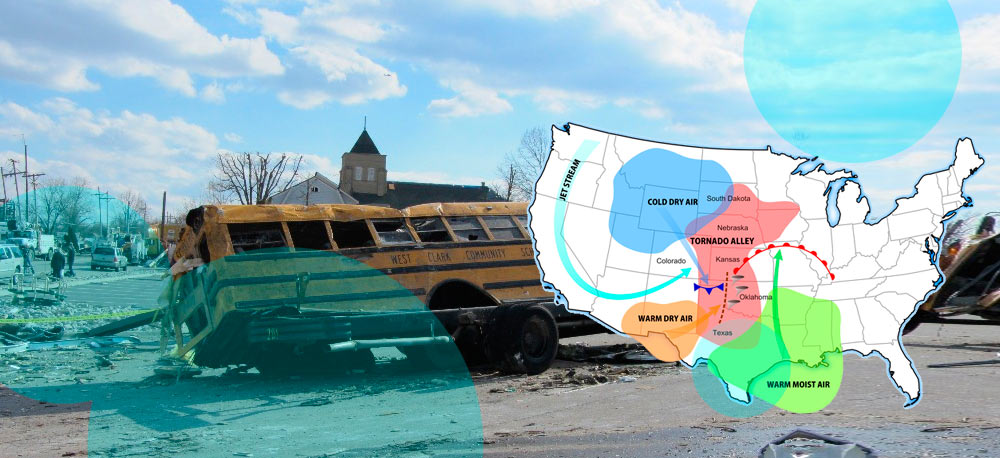
Record tornado activity in Illinois, Indiana and Wisconsin is increasing insurance exposure as severe storms extend farther east into more densely populated areas. Verisk said recent losses reflect where tornadoes are occurring and the amount of property in their path, rather than a sustained increase in national tornado counts.
Illinois recorded 220 confirmed tornadoes through the end of July 2026, the highest total among US states. Indiana and Wisconsin also reached record levels during the year.
Illinois has now experienced its third major tornado spike in five years. Tornado activity in 2026 already exceeds the combined totals for 2024 and 2025, while average severity has increased fourfold since 2022, according to Verisk.
Most of this year’s Illinois activity was concentrated in June and July. Cook, Kankakee and Coles counties accounted for significant portions of the losses, with Kankakee recording an average estimate of about $104,000.
Wisconsin recorded an even sharper year-over-year increase in tornado activity, rising 672%. Verisk said much of that increase came from one concentrated July event in Winnebago County.
The traditional Tornado Alley has long been associated with states including Texas, Oklahoma and Kansas. Recent activity has increasingly extended into the Midwest and farther east, where greater population density raises the potential cost of individual storms.
“The Tornado Alley’s kind of expanding or shifting a bit eastward,” said Tory Farney, vice president of Verisk Weather Solutions. He said one of the main insurance concerns is the larger concentration of people and property in areas farther east.
Verisk’s data shows national tornado claim volume declining even as average losses become more severe. Tornado volume peaked in 2023 and has fallen each year since, while average estimated reconstruction values have increased annually.
Average estimated reconstruction value is now 72% above its 2022 level. That means fewer tornado claims nationally don’t necessarily translate into lower insured losses when storms hit more expensive or densely developed areas.
Researchers are still examining whether the geographic shift will persist. Farney said the movement is measurable, although there remains uncertainty over whether it will continue or eventually reverse.
Climate change is one possible factor under study. Warmer conditions allow more humid air to extend farther north and east, but researchers are also examining large-scale patterns such as the Pacific Decadal Oscillation and Atlantic Multidecadal Oscillation.
The change isn’t limited to tornadoes. Verisk has observed similar eastward movement in hail, damaging wind and flash flooding associated with severe thunderstorms.
The pattern adds to growing losses from severe convective storms. Verisk reported last year that the number of severe thunderstorm events producing more than $1 bn in insured losses increased 59% between 2020 and 2024 compared with 2015 through 2019.
Severe thunderstorms, wildfires and winter storms are among the frequency perils contributing heavily to catastrophe losses. Inland flooding is also included in that group, which accounted for $98 bn of Verisk’s modeled $152 bn in average annual catastrophe losses.
Exposure growth is adding further pressure. Verisk found that property exposure across its modeled countries increased by an average of 7.3% annually between 2020 and 2024.
The company attributed that increase to new construction and higher replacement costs. As severe storms occur more often in populated eastern areas, those exposure trends increase the amount insurers stand to lose from individual events.