- JPMorgan Chase reported Q3 2026 net income of $15.3 bn, or $5.57 per share, below the $5.85 LSEG consensus. Revenue increased 8% year over year to $50.2 bn.
- Equity trading revenue surged 49%, but fixed-income trading declined 4%. Investment banking fees increased 14% annually but fell 8% from the second quarter.
- Wall Street’s 12-month consensus price targets range from approximately $363 to $372, with individual forecasts reaching $420. JPMorgan projects net interest income excluding markets of about $107 bn in 2027.
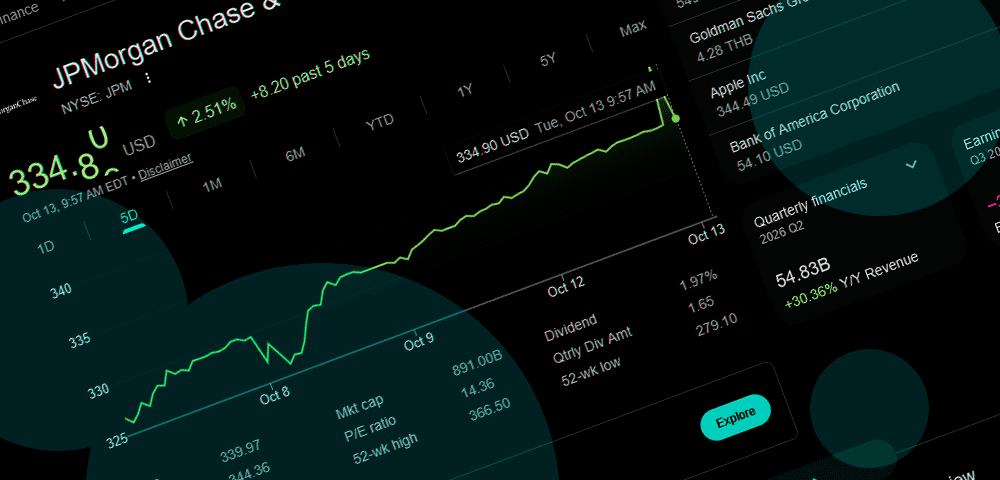
JPMorgan Chase (NYSE: JPM) shares were trading near $336 in early trading on October 13, 2026, after the largest U.S. bank reported its first quarterly earnings miss since the fourth quarter of 2023. The results exposed weaker investment banking and fixed-income trading activity, although lending growth and a stronger interest income outlook helped support the stock.
JPMorgan earned $15.3 bn in the third quarter, up 6% year over year. Diluted earnings per share increased 10% to $5.57, below the $5.85 consensus compiled by LSEG. Reported revenue rose 8% to $50.2 bn, while revenue on a managed basis reached $50.9 bn.
The earnings shortfall partly reflected $658 mn in investment securities losses, equivalent to an after-tax reduction of $0.18 per share. Excluding that item, EPS reached $5.75, still below market expectations.
JPMorgan investment banking and trading results
Investment banking fees increased 14% year over year to approximately $3 bn but declined 8% compared with the second quarter. The slowdown followed a strong first half of 2026, which included SpaceX’s landmark initial public offering.
Markets revenue increased 15% to $10.3 bn, supported by a 49% surge in equity trading revenue to $5 bn. Fixed-income trading revenue fell 4% to $5.4 bn, missing analyst expectations.
Chris Marinac, director of research at Janney Montgomery Scott, identified weaker-than-expected fixed-income trading and equity and debt underwriting as contributors to the earnings disappointment.
Consumer banking provided a more stable source of growth. Net interest income excluding markets rose 6% to $24.7 bn, while average loans and deposits increased 10% and 8%, respectively.
The bank’s credit loss provision totaled $2.7 bn, including $2.2 bn in net charge-offs and a $539 mn reserve build. Operating expenses increased 12% to $27.3 bn.
CEO Jamie Dimon said the U.S. economy continued to benefit from business investment and consumer spending, although inflation, higher interest rates and geopolitical uncertainty remained concerns.
JPMorgan stock price targets and 2027 forecast
Wall Street remains generally positive on JPMorgan shares despite the earnings miss.
As of October 13, S&P Global’s consensus of 25 analysts indicated an average 12-month price target of $372.14, approximately 11% above the early-session trading price. MarketBeat’s separate consensus stood at $362.88, implying roughly 8% upside.
Recent individual analyst forecasts include:
- Barclays: $420, Buy.
- Bank of America: $400, Buy.
- UBS: $395, Buy.
- TD Cowen: $370, Hold.
These targets were issued before the October 13 earnings release and may be revised as analysts incorporate the latest results.
The bank’s interest income outlook provides support for its medium-term earnings prospects. JPMorgan expects 2026 net interest income of approximately $106.2 bn, including markets, and $97.2 bn excluding markets.
Its preliminary forecast for 2027 calls for approximately $107 bn in net interest income excluding markets, an increase of about 10% from the 2026 projection.
At approximately $336 per share, JPMorgan trades near 14 times analysts’ estimated 2026 earnings of $24.13 per share. That valuation is not particularly demanding relative to the bank’s profitability, although earnings estimates may change following the quarterly release.
The main risk is that higher interest rates and borrowing costs weaken credit demand and increase loan losses. Further declines in underwriting activity or fixed-income trading could also constrain earnings growth.
JPMorgan’s return on tangible common equity remained at 20% in the third quarter, supported by a common equity Tier 1 capital ratio of 13.9%.
For the next 12 months, the $363–$372 analyst consensus range suggests moderate appreciation potential rather than another substantial rally. A move toward $395–$420 would require stronger earnings momentum and a recovery in capital markets activity, while weaker credit conditions could put pressure on the stock.
The October results show a bank continuing to expand profits and lending income, but facing higher expectations for its trading and investment banking operations. Its preliminary 2027 interest income forecast is the clearest positive development for investors assessing the shares after the earnings miss.