Follow Beinsure
- Goldman Sachs and Bank of America maintain bullish NBIS forecasts
- Citi and BNP Paribas expect stronger AI cloud growth
- Morgan Stanley and Rothschild see significant downside risks
- Nebius revenue growth supports bullish forecasts
- Nebius financing and dilution remain major valuation concerns
- Microsoft spending raises questions about near-term AI infrastructure demand
- Nebius stock forecast for 2027: Revenue growth versus profitability
- NBIS stock price outlook: What analysts expect next
Nebius Group N.V. (NASDAQ: NBIS) remains a predominantly bullish call among Wall Street analysts, although investment banks disagree sharply over how much investors should pay for the AI infrastructure company’s future growth.
As of October 29, 2026, the average 12-month NBIS stock price target stands at $281, based on estimates from 22 analysts compiled by S&P Global. The median forecast is higher at $302, indicating that several cautious valuations are pulling down the average.
- Wall Street’s average 12-month price target for Nebius Group (NASDAQ: NBIS) stands at $281, implying 54.1% upside from the October 28 closing price of $182.34. Individual forecasts range from $84 to $410.
- Goldman Sachs maintains a $328 target, Citi forecasts $324 and Bank of America expects $310. BNP Paribas Exane is more optimistic at $399, while Morgan Stanley and Rothschild & Co Redburn have substantially lower valuations.
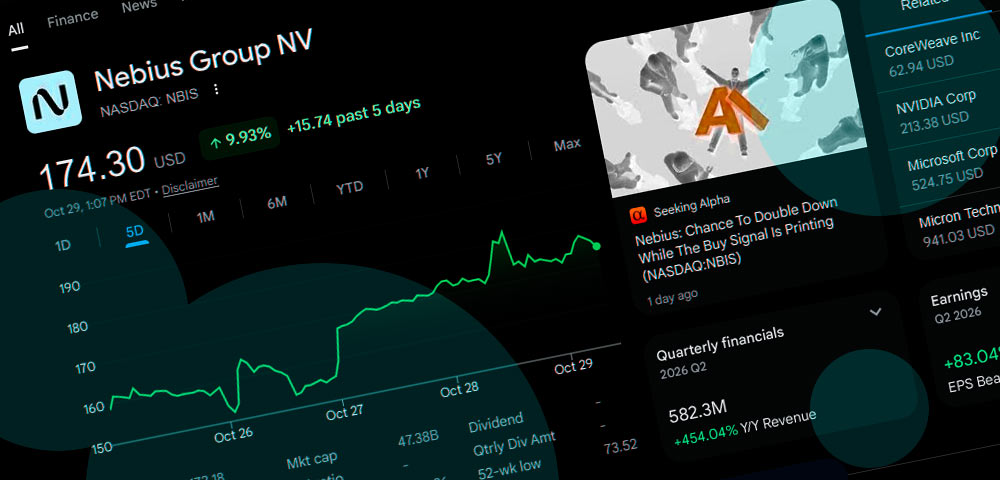
- Nebius reported 454% revenue growth in Q2 2026, but heavy capital expenditure, convertible debt and potential shareholder dilution remain central to its valuation. Shares came under renewed pressure on October 29 following Microsoft’s latest earnings.
Against the October 28 closing price of $182.34, the consensus implies approximately 54% potential appreciation. Shares fell again during October 29 trading as concerns about AI infrastructure spending weighed on specialist cloud providers.
The disagreement among analysts is substantial. Goldman Sachs, Citi, Bank of America and BNP Paribas Exane expect significant appreciation, supported by Nebius’s expanding GPU capacity, multibillion-dollar customer contracts and rapid revenue growth.
Morgan Stanley, Piper Sandler and Rothschild & Co Redburn take a more cautious view. Their concerns centre on capital intensity, financing costs, competitive pressures and whether current AI computing prices can support the company’s valuation over the long term.
Goldman Sachs and Bank of America maintain bullish NBIS forecasts
Goldman Sachs analyst Alexander Duval maintained a Buy rating on Nebius and raised the firm’s price target to $328 from $286 on August 25, 2026. The revision reflected stronger expectations for the company’s AI cloud operations and its ability to finance infrastructure development.
Goldman’s investment case centres on customer demand, capacity expansion and financing arrangements that reduce reliance on conventional corporate borrowing. Nebius has increasingly used customer prepayments, long-term contracts and infrastructure-backed financing to support growth.
These arrangements matter because constructing AI data centres and acquiring high-performance GPUs requires substantial upfront investment, often before new capacity begins generating revenue.
Bank of America Securities analyst Tal Liani reiterated a Buy rating and $310 price target on October 22, making it one of the more recent major investment bank assessments of Nebius.
The bank expects Nebius’s adjusted EBITDA margin to remain broadly stable at approximately 40.7% in the third quarter of 2026, as additional operating costs associated with bringing new data centres online offset some benefits from higher revenue and infrastructure utilisation.
Bank of America estimates third-quarter capital expenditure at approximately $6.6 bn, illustrating the investment required to support the company’s expansion.
Both banks expect Nebius to benefit from rising demand for AI computing, but their valuations depend on the pace at which new infrastructure becomes operational and begins generating revenue.
Citi and BNP Paribas expect stronger AI cloud growth
Citi analyst Tyler Radke maintains a Buy recommendation and a $324 price target for NBIS shares. The bank raised its forecast from $278 in August following Nebius’s second-quarter results and improved visibility into its AI infrastructure contracts.
BNP Paribas Exane issued a more aggressive forecast on September 24, upgrading Nebius from Neutral to Outperform and increasing its target to $399 from $260, a revision of more than 53%.
The upgrade followed developments in Nebius’s commercial operations, including announced increases in GPU cloud pricing.
The company notified customers of price increases of approximately 17-21% across selected NVIDIA H100, H200, B200 and B300 GPU services, effective October 1, 2026. Pricing for certain AMD EPYC CPU services was also set to increase.
Higher prices could improve revenue per unit of computing capacity, provided customer utilisation and demand remain strong.
Other bullish forecasts include Truist Securities’ $355 target, Rosenblatt Securities’ $304 target and Northland Securities’ $410 target.
Truist expects Nebius could exceed prevailing estimates for 2027 recurring revenue, supported by contract pricing and expanding capacity.
Rosenblatt initiated coverage in October with a Buy rating, placing Nebius among the leading specialist AI cloud providers alongside CoreWeave.
Its valuation incorporates expectations for substantial capacity expansion through 2030. Rosenblatt estimates that Nebius’s active computing capacity remains considerably smaller than CoreWeave’s, leaving room for growth if planned infrastructure becomes operational.
Northland’s valuation represents the upper end of widely reported forecasts.
Morgan Stanley and Rothschild see significant downside risks
Not every investment bank expects Nebius shares to appreciate.
Morgan Stanley maintains an Equal-weight stance, with a reported $144 target reaffirmed in August. Its cautious assessment contrasts with the stronger growth assumptions underlying most Buy recommendations.
Piper Sandler analyst James Fish lowered his target from $237 to $185 on October 21 while retaining a Neutral rating.
The reduction followed a broader reassessment of AI cloud valuations, particularly concerns about financing requirements, returns on invested capital and free cash flow.
Piper Sandler reduced its long-term valuation multiples across the specialist AI cloud sector. The firm expects investor sentiment to remain sensitive to evidence that infrastructure providers can improve cash generation and secure additional financing.
Rothschild & Co Redburn presents the most bearish assessment. Analyst Alexander Haissl initiated coverage with a Sell recommendation and an $84 price target in September.
Rothschild’s argument focuses on the difference between equity market expectations and the financial risks associated with building large AI computing facilities.
The firm believes credit markets are reflecting risks that equity investors may be underestimating, particularly the economic commitments of hyperscale customers supporting AI infrastructure expansion.
It also questions whether current computing prices and projected profitability can remain sustainable as supply expands.
The unusually wide dispersion in analyst valuations reflects different assumptions about future revenue, capital costs, margins and the economic life of GPU infrastructure.
Nebius revenue growth supports bullish forecasts
Nebius’s second-quarter 2026 financial results provide the strongest evidence supporting higher analyst valuations.
Revenue increased 454% year over year to $582.3 mn, compared with $105.1 mn in the corresponding quarter of 2025. AI cloud revenue reached approximately $575 mn, accounting for nearly all consolidated sales.
Adjusted EBITDA improved to $236.2 mn from a $21 mn loss a year earlier, producing an adjusted EBITDA margin of approximately 40.6%.
The company nevertheless reported a $190.4 mn net loss from continuing operations, compared with net income of $502.5 mn a year earlier.
Depreciation and amortisation reached $259.7 mn, while share-based compensation expenses totalled $102.5 mn.
These figures explain why adjusted EBITDA alone provides an incomplete picture of Nebius’s profitability. The metric excludes substantial expenses associated with the assets and compensation required to operate and expand the business.
Nebius reported annualised run-rate revenue of approximately $3 bn at the end of June, an increase of 598% year over year.
Management reaffirmed its 2026 revenue guidance of $3-3.4 bn and its target of $7-9 bn in annualised run-rate revenue.
During the second quarter, Nebius signed four major AI cloud contracts, each worth more than $1 bn. Customers included Reflection, Cohere, another AI laboratory and a large US quantitative trading company.
The agreements were priced at approximately $20-25 mn in annual revenue per megawatt of computing capacity. Customer prepayments covered an estimated 50-60% of associated capital expenditure, reducing the amount Nebius needed to finance independently.
Management indicated that demand was sufficient to sell its planned 2027 capacity at prevailing contract terms, although it intended to reserve some capacity for potentially higher-paying customers.
The financial challenge is converting those contracts into revenue and sustainable cash flow without disproportionately increasing debt or the number of shares outstanding.
Nebius financing and dilution remain major valuation concerns
Nebius’s expansion requires investment well beyond its current annual revenue.
Purchases of property, equipment and intangible assets totalled approximately $5.66 bn during Q2 2026, compared with $510.6 mn a year earlier. For the first six months of 2026, those purchases reached approximately $8.13 bn.
The company has been raising substantial capital to support its planned infrastructure development.
In August, Nebius completed a $5.75 bn convertible senior notes offering, consisting of $3.45 bn of notes due in 2030 and $2.3 bn due in 2034.
The initial conversion prices were approximately $313.46 and $324.65 per Class A ordinary share, respectively. Those prices are materially higher than the company’s late-October trading level, but future conversion could increase the number of shares outstanding.
Nebius also exchanged $800 mn of previously issued convertible notes for approximately 15.8 mn Class A shares as part of its August financing transactions.
This exchange involved an actual issuance of shares, unlike potential dilution that depends on future conversion of the new notes.
On October 22, Nebius announced an additional $3.5 bn senior secured financing facility arranged by Citi.
The facility carries an initial interest margin of 2.75 percentage points above Term SOFR, increasing over time to a maximum of 3.50 percentage points above the benchmark, subject to contractual adjustments.
It matures in October 2027 and is intended to support data centre development and GPU procurement.
Nebius has also highlighted more than $40 bn in long-term customer commitments with investment-grade counterparties as a basis for potential asset-backed financing.
Additional financing allows Nebius to accelerate infrastructure construction and potentially capture AI computing demand before competitors. At the same time, debt increases financial obligations, while convertible securities and equity transactions can dilute existing shareholders.
The company’s ability to finance new GPU deployments at attractive rates will influence whether its revenue growth translates into higher value per share.
Microsoft spending raises questions about near-term AI infrastructure demand
Nebius shares came under additional pressure on October 29 after Microsoft reported quarterly capital expenditure, including finance leases, of $45.2 bn, below market expectations of approximately $50.7 bn.
Microsoft attributed part of the shortfall to timing differences involving third-party computing capacity deliveries and payments.
The announcement affected specialist AI infrastructure providers, including Nebius, CoreWeave and IREN.
Microsoft is an important customer for Nebius. Their September 2025 agreement covers dedicated GPU infrastructure capacity with an initial contract value of approximately $17.4 bn through 2031, potentially increasing to $19.4 bn if additional services are purchased.
Delays in third-party infrastructure delivery are consequently relevant to Nebius’s investment outlook.
The lower-than-expected Microsoft expenditure does not necessarily indicate weaker underlying demand for AI computing. Delayed data centre construction, power availability and equipment installation can also postpone expenditure and revenue recognition.
For Nebius, the operational risk is that capital has already been committed to projects that take longer than expected to become revenue-generating.
Nebius stock forecast for 2027: Revenue growth versus profitability
Analyst estimates suggest that Nebius could continue expanding rapidly beyond 2026.
Current aggregated forecasts indicate approximately $3.35 bn in revenue for 2026 and $12.24 bn for 2027, representing an increase of about 265%.
Yet earnings estimates remain negative, with projected losses per share of approximately $2.10 in 2026 and $3.60 in 2027.
These projections indicate that the anticipated expansion in revenue may not produce immediate GAAP profitability as infrastructure investment, depreciation and other costs increase.
The outcome depends heavily on how quickly new capacity is deployed and how effectively Nebius can convert contracted demand into cash-generating operations.
Higher contract prices and customer prepayments could support the bullish investment case. A deterioration in financing conditions, lower GPU utilisation or additional share issuance would strengthen the more cautious arguments.
Nebius also faces competition from established hyperscalers and specialist infrastructure providers, including CoreWeave and IREN. Changes in computing supply or GPU economics could affect future contract pricing and returns on invested capital.
NBIS stock price outlook: What analysts expect next
The consensus forecast indicates substantial recovery potential for Nebius, but the company’s valuation remains dependent on the economics of its infrastructure expansion.
With shares below their 52-week high of $299.86, investors are weighing rapid revenue growth and long-term customer commitments against mounting capital requirements and possible dilution.
Nebius’s next financial results will provide additional evidence on whether revenue continues to accelerate, adjusted EBITDA margins remain stable and newly installed capacity begins contributing to cash generation.
Customer prepayments, financing costs, infrastructure deployment schedules and changes in outstanding shares will be particularly important.
The central question for NBIS shareholders is whether Nebius can convert its expanding AI computing business into sustainable returns after accounting for the costs of building, financing and maintaining its infrastructure.