- Polygrade has emerged from stealth with $6.3mn in funding from Construct Capital, American Family Ventures and Nine Four Ventures to develop its AI-native warranty claims management platform.
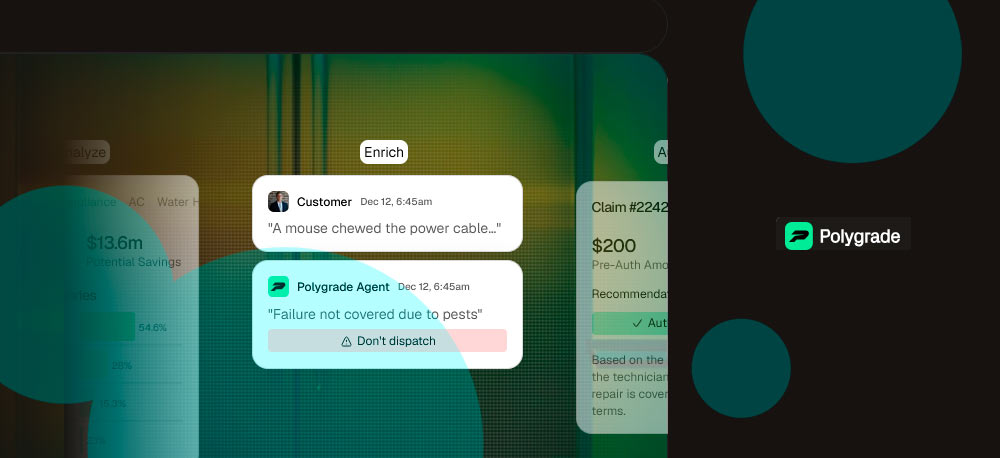
- The platform uses specialized AI agents to manage five stages of the claims lifecycle, from first notice of loss and pre-dispatch triage to authorization, parts procurement and contractor payment.
- Already working with Fidelity National Home Warranty and Cinch Home Services, Polygrade plans to expand beyond home warranty into extended warranty, OEM warranty and equipment breakdown insurance.
Polygrade, an AI-native warranty claims management platform, has emerged from stealth with $6.3mn in funding from Construct Capital, American Family Ventures and Nine Four Ventures. The Toronto-based company is developing AI agents designed to automate insurance and warranty claims operations, from initial diagnosis through repair authorization, parts procurement and contractor payment.
Founded by executives with experience at Sears Home Services and Thumbtack, Polygrade is initially targeting the home warranty market, where claims management software has traditionally focused on recording information, routing service requests and tracking cases through established workflows.
Polygrade takes a different approach, using specialized AI agents to perform operational tasks and support decisions throughout the claims process.
The platform helps warranty providers identify equipment failures, determine appropriate next steps and coordinate repairs. Automating work across existing systems is intended to reduce unnecessary contractor visits, accelerate repairs, control claim severity and operating expenses, and improve visibility into claims activity.
Contractors could benefit from faster authorizations, parts ordering and payments, while homeowners may experience shorter repair times and more predictable service.
Rather than requiring warranty providers to replace their existing technology, Polygrade operates above their current systems. It converts claims data into operational actions while developing what the company describes as a proprietary intelligence graph linking policies, claims, decisions and outcomes. Information generated by individual claims can subsequently inform future decisions.
“Warranty is a massive industry that never really got its modern software moment,” said David Steckel, Founder and CEO of Polygrade. “The technology that exists is largely designed to keep track of a claim and move it through a workflow.
We built Polygrade to understand the claim and act on it. If AI can help determine what’s wrong before a contractor gets in a truck, find the right part at the right price, make an authorization decision and get a contractor paid faster, the economics of the entire claim change.
David Steckel, Founder and CEO of Polygrade
The company is already operating in production environments with enterprise warranty providers, including Fidelity National Home Warranty. Its supplier relationships include Encompass, UED, Sibi and Marcone.
“Encompass is excited about its partnership with Polygrade,” said Robert Coolidge, President and CEO of Encompass. “Encompass has long been a leading supplier of OEM replacement parts to the warranty industry, and this partnership strengthens our commitment to helping warranty providers improve parts availability, access more competitive pricing, and deliver the industry’s highest service levels.”
Polygrade’s founding team combines experience in home services operations, warranty technology and artificial intelligence.
Steckel previously founded Setter, a home management platform backed by Sequoia Capital that was subsequently acquired by Thumbtack. He later helped develop Thumbtack’s home services businesses before becoming Chief Product Officer at Sears Home Services, where he modernized warranty integrations and the company’s direct-to-consumer product.
His experience at Sears exposed recurring operational problems involving claims decisions, parts procurement, invoice disputes and delayed contractor payments.
Co-founder and CTO Eui Chung spent nearly 30 years at Sears and Transformco, where he led the AI transformation of Sears Home Services. Kaustubh Vongole, Polygrade’s co-founder and Head of Product, previously led fulfillment products and AI strategy.
“David, Eui and Kaustubh have an unusual combination of deep domain expertise and technical experience,” said Rachel Holt, Cofounder & Managing Partner at Construct Capital.
They’ve run these operations at scale and understand why applying AI to a complex enterprise workflow requires much more than building a model. Polygrade has the potential to become the intelligence and execution layer for a massive category that has been largely overlooked by modern software.
Rachel Holt, Cofounder & Managing Partner at Construct Capital
Polygrade’s platform covers five stages of the warranty claims lifecycle: first notice of loss, pre-dispatch triage, authorization, parts procurement and payment.
Its AI agents operate according to rules and decision thresholds established by each warranty company. Cases falling outside those parameters are escalated for human review, allowing providers to retain oversight of exceptions.
Fidelity National Home Warranty has deployed the technology within its existing operations, including claims intake and parts procurement.
Polygrade accomplished both of those goals, while not requiring a wholesale replacement of the systems warranty companies depend on. We take our time, and we validate pilots before we scale. Polygrade stood out for bringing practical AI into our existing workflows, from smarter claims intake to parts procurement.
Jason Manns, EVP and COO at Fidelity National Home Warranty
Early deployments have identified unnecessary service visits, repairs unlikely to resolve reported problems and excessive spending on parts procurement.
Polygrade intends to use the $6.3 mn investment to expand its Forward Deployed Engineering, go-to-market and partner enablement teams.
The company also plans to extend its technology beyond home warranty claims into extended warranties, original equipment manufacturer warranties and equipment breakdown insurance.
“There are enormous categories where a claim ends with something physical needing to be repaired or replaced,” Steckel said. “We think the infrastructure for managing those claims is going to look very different in an AI-native world.”