Follow Beinsure

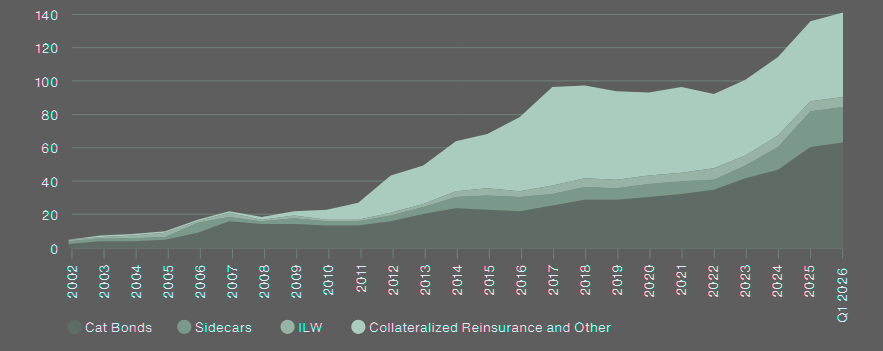
Third-party reinsurance capital represented approximately $141 bn of limit as of March 31, 2026, according to Aon. The total covers catastrophe bonds, sidecars, industry loss warranties and collateralized reinsurance.
Growth during the first quarter was driven primarily by 144A catastrophe bond issuance. Sidecar capacity was broadly unchanged over the period, although investor interest in several sidecar structures remained strong.
Sidecars continue to account for a substantial part of insurance-linked securities activity in 2026. Aon reported particular interest in asset-driven vehicles covering casualty and whole-account portfolios.
Under these structures, investors assume both investment risk and underwriting risk through the vehicle. Cedents are using them to access additional capacity and negotiate more favorable commission terms while supporting premium growth.
Demand has been strongest for casualty and whole-account sidecars. Aon attributed that interest partly to still-elevated insurance rates in those classes and opportunities to invest supporting assets at higher yields.
The broker expects further transactions of this type during the remainder of 2026. Overall sidecar capital deployment, however, remained broadly stable through the first quarter.
Third Party Capital Deployment (Limit in $ bn)
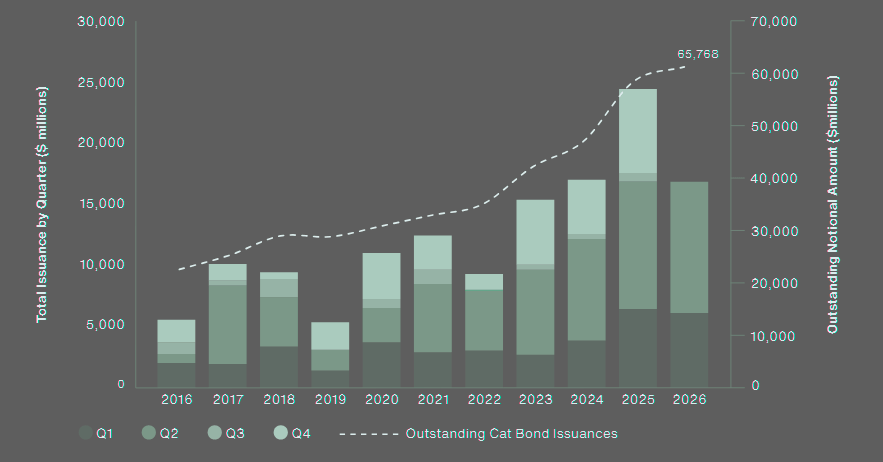
Catastrophe bonds remain the largest established instrument within the wider ILS market. Outstanding catastrophe bond capacity exceeded $65 bn by the end of the second quarter of 2026 after another active issuance period.
New catastrophe bond issuance totaled $17.1 bn during the first six months of 2026. That exceeded the $10.4 bn of bonds maturing over the same period, producing a net increase in outstanding market capacity.
Issuance remained strong following record activity in 2025. Pricing was competitive but relatively stable during the second quarter as investor demand absorbed the volume of new transactions.
Secondary-market catastrophe bond spreads returned to approximately 2021 levels, according to Aon. Spreads were broadly stable during the first quarter before tightening by about 3% over the following 11 weeks.
Aon linked the tightening to greater investor capital available for deployment heading into peak Atlantic wind season. Additional demand for catastrophe bond risk placed downward pressure on spreads despite continued issuance.
Average catastrophe bond transaction size reached $285 mn during H1 2026. That was 12% above the 2024 average and approximately 3% higher than the average transaction size recorded in 2025.
- 9 cedents completed catastrophe bond transactions exceeding $500 mn during the first half. Aon said larger placements show that some buyers are transferring a greater share of their reinsurance requirements into the ILS market.
- For cedents, catastrophe bonds currently provide access to multi-year protection with pricing fixed for the term of the transaction. Strong investor demand has also allowed sponsors to place larger amounts of capacity through the market.
P&C Catastrophe Bond Issuances by Quarter (Limit in $ mn)
Investor returns remained positive during the first half of the year. Aon’s catastrophe bond index returned 3.42% year-to-date through June 12, 2026, compared with 2.84% over the same period in 2025.
The index return reflects catastrophe bond spread income and returns earned on collateral supporting the securities. Aon also reported no principal impairments during the year-to-date period covered by the data.
Collateral yields remained elevated as well, adding to total catastrophe bond returns. The asset class also continued to offer diversification relative to traditional credit markets, where spreads remained historically narrow.
Catastrophe bond returns typically increase during the wind season because investors earn additional risk premium while hurricane exposure remains outstanding. That pattern depends on catastrophe experience, as major qualifying losses could reduce returns or impair principal.
With more than $65 bn of outstanding catastrophe bond capacity and $141 bn of total third-party reinsurance limit at the end of March, alternative capital remains a substantial source of reinsurance capacity. In 2026, growth has been concentrated in catastrophe bonds while sidecar activity has shifted toward more asset-intensive casualty and whole-account structures.