- S&P 500 futures rose 0.2% and Dow futures gained 0.4%, while Nasdaq futures slipped 0.1% as investors awaited US consumer inflation figures.
- September headline inflation is forecast to accelerate to 3.6% annually from 3.4%, with higher energy prices potentially affecting the Federal Reserve’s monetary policy outlook.
- Bank earnings showed mixed results, with fixed-income trading weakness at JPMorgan and Goldman Sachs, while concerns about AI financing continued to influence technology stocks.
US stock index futures were mixed on October 14 as investors prepared for September inflation data and another round of major bank earnings, with concerns about artificial intelligence financing also influencing market sentiment.
At 05:37 ET (09:37 GMT), S&P 500 futures were up 14 points, or 0.2%, while Nasdaq futures declined 22 points, or 0.1%. Dow Jones futures gained 217 points, equivalent to 0.4%.
Wall Street’s main indexes closed lower in the previous session, partly reflecting renewed questions about the financial outlook for leading artificial intelligence developers, particularly OpenAI and Anthropic.
Large technology companies operating extensive AI infrastructure performed better than the broader market. Analysts at Vital Knowledge attributed some of that resilience to the ability of major hyperscalers to finance capital expenditure through operating cash flow, reducing their dependence on debt-funded investment.
The distinction has become relevant as investors assess the volume of financing arrangements supporting AI infrastructure development and the valuations anticipated for privately held AI companies.
According to media reports, Anthropic, the developer of the Claude chatbot, is preparing to disclose its third-quarter financial results for the first time on Wednesday. The anticipated release could provide investors with additional information about the company’s financial performance.
Financial stocks also contributed to the previous session’s weakness as investors assessed the first quarterly results from major US banks.
Shares of JPMorgan Chase, the largest US bank, declined after its fixed-income trading revenue unexpectedly fell. Goldman Sachs also traded lower after reporting fixed-income revenue below analysts’ estimates.
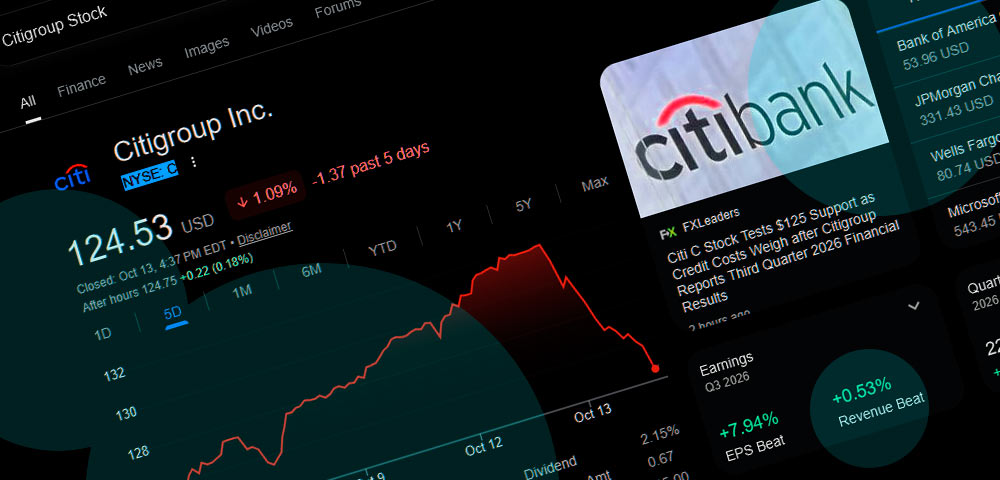
Citigroup recorded the steepest decline among constituents of the KBW Banks Index, with its shares falling 5.6%.
The results suggested that weakness in fixed-income trading was a particular concern for investors, even as broader quarterly bank performance remained largely consistent with expectations.
The immediate focus for financial markets is the September US consumer price index, which could influence expectations for Federal Reserve interest rate decisions during the remainder of 2026.
Headline consumer inflation is forecast to accelerate to 3.6% year over year in September, compared with 3.4% in August. On a monthly basis, consumer prices are expected to rise 0.6%, up from the previous month’s 0.4% increase.
The anticipated acceleration reflects higher energy costs, which could complicate the inflation outlook as policymakers consider the appropriate direction of monetary policy.
The bank’s economists expect motor fuel prices to have increased by 0.6% during the month.
Core consumer inflation, which excludes volatile food and energy prices, is projected to reach 2.5% annually, compared with 2.4% in August. The monthly core inflation rate, however, is expected to ease to 0.2% from 0.3%.
The difference between headline and core inflation could provide an indication of how much recent price pressure is concentrated in energy rather than spread across other categories of consumer spending.
Alternative inflation data provider Truflation warned that the “gap between headline and core is widening,” citing persistently elevated energy prices associated with an expanding conflict in the Middle East.
The firm also identified aggressive US trade policies as a potential source of renewed goods inflation, adding another consideration for investors assessing the Federal Reserve’s policy options.
Corporate earnings will provide a second major source of market direction, with additional Wall Street financial institutions reporting third-quarter results.
Bank of America reported a decline in quarterly profit after setting aside $1.2 bn in provisions related to US fines concerning failures to identify potentially illicit activity. Its shares fell in premarket trading following the announcement.
Asset manager BlackRock delivered higher third-quarter profit, supported by increased fees earned from managing client assets. Its shares advanced before the opening bell.
The contrasting results added to an earnings season in which investor attention has focused on trading revenue, profitability and whether favorable operating conditions for financial institutions can persist.
The earnings released so far by major banks had not necessarily been “bad,” with most results broadly meeting expectations apart from weakness in fixed-income trading.
Their larger concern was the possibility that the industry’s current operating environment represents a peak rather than the beginning of further improvement.
For investors, inflation release and the remaining bank results will provide further evidence on two immediate questions: whether inflationary pressures could constrain Federal Reserve policy and whether major financial institutions can sustain their recent performance as market conditions change.