Overview
- Cisco stock price forecast
- Cisco’s fiscal 2026 earnings strengthen the AI investment case
- AI infrastructure orders reach $9.3 bn
- Cisco forecasts FY2027 revenue of up to $73.4 bn
- Can Cisco maintain profitability despite rising memory costs?
- Cisco expands AI security and collaboration investments
- Is Cisco stock expensive after its 2026 rally?
- What could move Cisco stock in the coming months?
Cisco Systems (NASDAQ: CSCO) enters October 12, 2026, with strong investor interest following a year of accelerating artificial intelligence infrastructure demand, record financial results and upward revisions to earnings expectations.
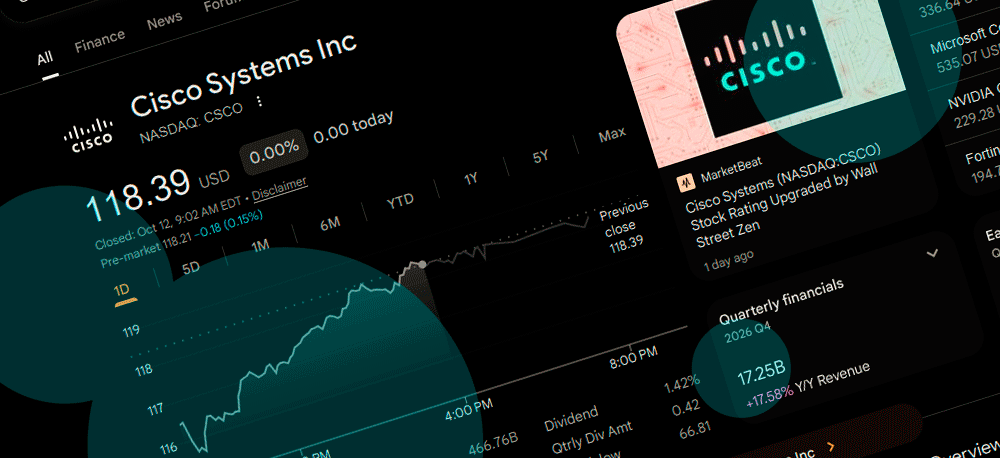
The networking and cybersecurity company’s shares closed at $118.39 on October 9, rising 3.05% during the session after declining 2.13% the previous day. Cisco has gained approximately 54% since the beginning of 2026, significantly outperforming its traditional reputation as a mature networking equipment supplier.
Wall Street’s outlook remains favorable, although analysts disagree over how much additional growth is already reflected in the share price.
- Cisco Systems closed at $118.39 on October 9, 2026, gaining 3.05% in the session. Analyst consensus targets range from $128.52 to $136.16 across major forecasting platforms, implying potential upside of approximately 8.6% to 15%.
- Cisco reported record fiscal 2026 revenue of $63.3 bn, up 12%, while hyperscaler AI infrastructure orders reached $9.3 bn. Management expects $7.5 bn in AI infrastructure revenue during fiscal 2027, supporting its annual revenue forecast of $72.2 bn to $73.4 bn.
- Wall Street remains broadly positive on Cisco stock, with recent price targets ranging from $110 at Bernstein to $139 at Citi and $165 at Rosenblatt. Rising memory costs, pressure on hardware margins and a valuation of approximately 35.5 times trailing earnings remain important risks.
According to forecasts compiled from 29 analysts by S&P Global Market Intelligence, Cisco carries a consensus Buy rating and an average 12-month price target of $136.16, representing approximately 15% upside from its latest closing price. A separate MarketBeat survey of 26 analysts places the consensus target at $128.52, suggesting a more moderate potential gain of 8.6%.
The difference reflects variations in analyst coverage, target inclusion and calculation methodologies rather than a change in Cisco’s underlying financial performance.
The investment case is increasingly tied to AI networking equipment, particularly the high-speed infrastructure required to connect computing systems within hyperscale data centers. Cisco’s latest financial results indicate that demand extends beyond AI-focused customers, with enterprises also increasing spending on networking upgrades and security infrastructure.
Cisco stock price forecast
Analyst recommendations have become more favorable following Cisco’s fiscal fourth-quarter results, although recent research shows considerable disagreement about the stock’s valuation.
Citi maintained its Buy rating and $139 price target on October 9, 2026, implying approximately 17.4% upside from the October 9 closing price.
Bernstein maintained a Hold rating and $110 target on October 7, representing a potential decline of approximately 7.1%. The difference between the two forecasts illustrates how expectations for AI infrastructure demand and future earnings growth influence analysts’ assessments.
Piper Sandler lowered its price target from $132 to $125 on September 22 while maintaining a Hold rating. Deutsche Bank initiated coverage with a Buy rating and $135 price target at the end of August. Truist Financial maintained its Buy recommendation with a $140 target.
Several analysts adopted more optimistic forecasts following Cisco’s August earnings announcement.
Wells Fargo increased its target from $130 to $150 while maintaining an Overweight rating. Rosenblatt Securities raised its target from $150 to $165 and reiterated Buy. Truist increased its forecast from $125 to $140.
HSBC moved in the opposite direction, downgrading Cisco from Buy to Hold and reducing its price target from $137 to $120 on August 14.
Bank of America has also maintained a constructive outlook, with a previously reported $150 price objective.
These forecasts suggest that analysts generally expect further appreciation, but the potential returns vary considerably depending on the assumptions used for revenue growth, margins and valuation multiples.
The S&P Global survey places the median 12-month target at $135, with individual estimates extending from $110 to $170. Importantly, these are analyst estimates rather than guaranteed future prices.
Cisco’s fiscal 2026 earnings strengthen the AI investment case
Cisco’s most recent quarterly earnings report, released on August 12, provides stronger evidence of its accelerating business momentum than the fiscal third-quarter figures published in May.
For the fourth quarter ended July 25, 2026, Cisco reported revenue of approximately $17.3 bn, an increase of 18% year over year. Revenue exceeded Wall Street expectations of about $16.84 bn.
Non-GAAP diluted earnings per share reached $1.22, above analysts’ consensus estimate of $1.17 and 23% higher than the corresponding quarter a year earlier.
GAAP earnings per share increased 52% to $0.97. The company reported GAAP net income of $3.9 bn, up 51%, while non-GAAP net income reached $4.9 bn. Its non-GAAP operating margin stood at 35.9%, compared with a GAAP operating margin of 24.7%.
For the full fiscal year, Cisco generated record revenue of $63.3 bn, an increase of 12% from $56.7 bn in fiscal 2025. GAAP net income rose 30% to $13.3 bn, while diluted earnings per share increased 31% to $3.33.
Adjusted earnings per share reached $4.33, compared with $3.81 a year earlier, representing 14% growth. These results represent an acceleration from Cisco’s historical growth profile, supported by stronger demand for data center networking equipment and enterprise infrastructure.
The fourth-quarter performance was also broad-based. Product revenue increased 24%, with networking revenue up 28%, security revenue rising 14%, collaboration revenue increasing 12% and observability revenue advancing 6%.
Services revenue was unchanged year over year. Geographically, revenue increased 18% in the Americas, 19% in Europe, the Middle East and Africa, and 14% across Asia Pacific, Japan and China.
AI infrastructure orders reach $9.3 bn
Artificial intelligence infrastructure has become one of Cisco’s most significant sources of incremental demand.
During fiscal Q4 2026, the company recorded approximately $4 bn in AI infrastructure orders from hyperscale customers, bringing the full-year total to $9.3 bn.
The result exceeded management’s earlier fiscal 2026 expectation of approximately $9 bn.
For context, Cisco had already accumulated $5.3 bn in AI infrastructure orders through the first three quarters, including $1.9 bn during fiscal Q3.
The acceleration in the final quarter indicates continued investment by large cloud operators in the networking systems needed to support AI computing clusters.
Cisco reported approximately $4 bn in AI infrastructure revenue during fiscal 2026 and expects that figure to increase to $7.5 bn in fiscal 2027.
The projected increase is substantial, although investors should distinguish between orders received and revenue recognized. Contract awards are not necessarily converted into sales within the same reporting period.
Demand extends beyond hyperscale AI infrastructure. Cisco’s total product orders increased 35% year over year during fiscal Q4, or 25% excluding hyperscale customers.
Networking product orders grew 40%, marking the eighth consecutive quarter of double-digit growth in that category.
Management has described the demand environment as a networking investment cycle supported by AI infrastructure requirements and enterprise upgrades.
For shareholders, the important question is whether that order growth can continue generating higher revenue and earnings as spending patterns evolve.
Cisco forecasts FY2027 revenue of up to $73.4 bn
Cisco’s guidance for fiscal 2027 indicates management expects its current expansion to continue.
The company forecasts annual revenue between $72.2 bn and $73.4 bn, representing approximately 14% to 16% growth from fiscal 2026.
Non-GAAP earnings per share are expected to reach $5.05 to $5.11, compared with $4.33 in the preceding year.
GAAP EPS is projected between $4.00 and $4.06. The company’s guidance was above the approximately $68.69 bn revenue consensus cited when its fiscal fourth-quarter results were released. More recent analyst forecasts have moved closer to management’s outlook.
S&P Global Market Intelligence data indicate an average fiscal 2027 revenue forecast of approximately $73.17 bn, with adjusted EPS estimated at $5.15.
For fiscal 2028, analysts currently project revenue of about $78.08 bn and adjusted EPS of $5.62. These estimates imply that Cisco’s growth may moderate after the sharp expansion expected in fiscal 2027, although the forecasts remain subject to revision as new earnings reports become available.
For fiscal Q1 2027, Cisco forecasts revenue of $18.0 bn to $18.2 bn and adjusted EPS between $1.32 and $1.34. The company expects a non-GAAP operating margin of 35.5% to 36.5%, alongside a non-GAAP gross margin of 65% to 66%.
The next quarterly earnings announcement, tentatively expected around November 11, 2026, will provide an important indication of whether Cisco is meeting these projections.
Can Cisco maintain profitability despite rising memory costs?
Cisco’s improving revenue outlook has not eliminated pressure on product margins. Higher memory component costs and changes in its product mix have affected profitability as the company increases its exposure to AI infrastructure hardware.
For fiscal Q4 2026, Cisco reported a non-GAAP product gross margin of 64.8%, compared with 67.5% a year earlier. The overall non-GAAP gross margin declined from 68.4% to 66.3%.
The company’s GAAP gross margin moved in the opposite direction, increasing to 64.1% from 63.2%, partly reflecting the absence of a supplier-related legal charge recorded in the previous year and the effects of pricing actions.
Cisco’s annual regulatory filing also identified higher memory costs and product mix as pressures on gross margins, partially offset by productivity improvements and pricing measures.
Management has introduced cost-reduction measures and price increases to mitigate these effects.
Its fiscal Q1 2027 adjusted gross margin guidance of 65% to 66% nevertheless indicates that cost pressures remain relevant.
A prolonged increase in component costs, particularly memory, could limit how much of Cisco’s anticipated revenue growth translates into additional profit.
Competition in networking hardware and changes in the composition of AI infrastructure demand are further considerations.
Cisco expands AI security and collaboration investments
Cisco is directing more resources toward artificial intelligence, networking silicon, optical infrastructure and cybersecurity.
In May 2026, the company announced plans to eliminate fewer than 4,000 positions, representing less than 5% of its workforce.
Chief Executive Chuck Robbins characterized the restructuring as a reallocation of investment toward businesses with stronger demand rather than a conventional cost-cutting program.
The company indicated that restructuring costs could reach $1 bn, with the plan expected to be substantially completed by the end of fiscal 2027.
Cisco has also expanded its capabilities through acquisitions. During fiscal Q4 2026, it completed the acquisition of Galileo Technologies, an observability specialist, and Astrix Securities, which focuses on non-human identity security.
These investments support Cisco’s efforts to combine networking infrastructure, cybersecurity and operational monitoring in enterprise environments. More recent announcements indicate that the company is extending its AI strategy beyond data center hardware.
On October 7, Cisco introduced new agentic collaboration capabilities for Webex, including plans to integrate Claude Managed Agents for enterprise analysis and multistep workflows.
The company also announced enhancements to its AI-powered customer experience platform and workplace technology, including expanded interoperability with Google Meet.
These product developments add potential commercial applications for Cisco’s AI investments, although their contribution to future revenue has not been quantified.
On October 9, Cisco appointed Girish Rishi, chairman and chief executive of industrial AI company Cognite, to its board of directors.
The appointment adds experience in enterprise data, AI systems and technology operations to Cisco’s governance structure.
Is Cisco stock expensive after its 2026 rally?
Cisco’s substantial share-price appreciation has increased the importance of valuation. At $118.39, the company has a market capitalization of approximately $466.76 bn.
The stock trades at roughly 35.5 times trailing GAAP earnings and approximately 23 times projected fiscal 2027 adjusted earnings.
Those figures use different earnings definitions and reporting periods, but illustrate the extent to which expected profit growth reduces the forward valuation multiple.
Cisco’s fiscal 2027 adjusted EPS guidance of $5.05 to $5.11 implies a forward multiple of approximately 23.2 to 23.4 at the October 9 closing price.
The shares consequently carry a valuation that assumes continued progress in AI networking, enterprise infrastructure and profitability.
Cisco also offers a source of shareholder returns beyond potential price appreciation. The company declared a quarterly dividend of $0.42 per share, payable October 21 to shareholders of record on October 2.
At the latest closing price, the annualized dividend of $1.68 represents a yield of approximately 1.42%. During fiscal Q4, Cisco returned $3.2 bn to shareholders, including $1.7 bn in dividends and $1.5 bn in share repurchases. Approximately $8.1 bn remained authorized under its repurchase program at the end of the period.
Operating cash flow reached $5.4 bn during the quarter, a 27% annual increase, providing additional financial capacity for investment and shareholder distributions.
What could move Cisco stock in the coming months?
Several measurable developments will determine whether Cisco’s operating performance supports further stock appreciation.
The most immediate is the pace at which hyperscaler AI infrastructure orders translate into revenue. Management’s $7.5 bn fiscal 2027 revenue expectation requires continued execution against a substantial pipeline of orders.
Enterprise networking demand is another important variable. Fourth-quarter product order growth of 25% excluding hyperscalers indicates that Cisco’s momentum is not limited to a small group of major cloud customers.
Profit margins will also influence investor expectations, particularly as rising memory costs continue to affect networking hardware economics.
A sustained decline in gross margins could offset some of the benefits of stronger sales.
The next fiscal Q1 earnings report will therefore be closely watched for results relative to the $18 bn–$18.2 bn revenue forecast, adjusted EPS guidance of $1.32–$1.34 and the projected 65%–66% gross margin.
Cisco enters that reporting period with substantial financial momentum and generally positive analyst sentiment. Its $9.3 bn in fiscal 2026 AI infrastructure orders, expected $7.5 bn in related fiscal 2027 revenue and full-year sales guidance of up to $73.4 bn provide a measurable basis for growth expectations.
At the same time, a share price already up approximately 54% in 2026 and trading at around 23 times projected adjusted earnings leaves future returns dependent on Cisco’s ability to sustain revenue expansion and protect profitability.
The average 12-month analyst forecasts of $128.52 to $136.16 indicate potential appreciation of approximately 8.6% to 15% from the October 9 closing price, with the next quarterly earnings report offering a direct test of those expectations.