Follow Beinsure
- D-Wave Quantum Stock Price Forecast: Analyst Consensus
- Latest Wall Street Price Targets and Investment Bank Revisions
- Second-Quarter Earnings Expose the Revenue Gap
- Revenue Forecasts Require a Sharp Fourth-Quarter Acceleration
- Is D-Wave Quantum Stock Overvalued?
- Quantum Annealing and Gate-Model Computing Drive Growth Expectations
- Shionogi Drug Discovery Research Demonstrates a New Application
- Securities Litigation and Management Changes Add Uncertainty
- November Earnings Will Test Wall Street’s Forecasts
D-Wave Quantum (NASDAQ: QBTS) continues to attract favorable Wall Street recommendations despite disappointing quarterly revenue, substantial operating losses and a sharp decline in its share price.
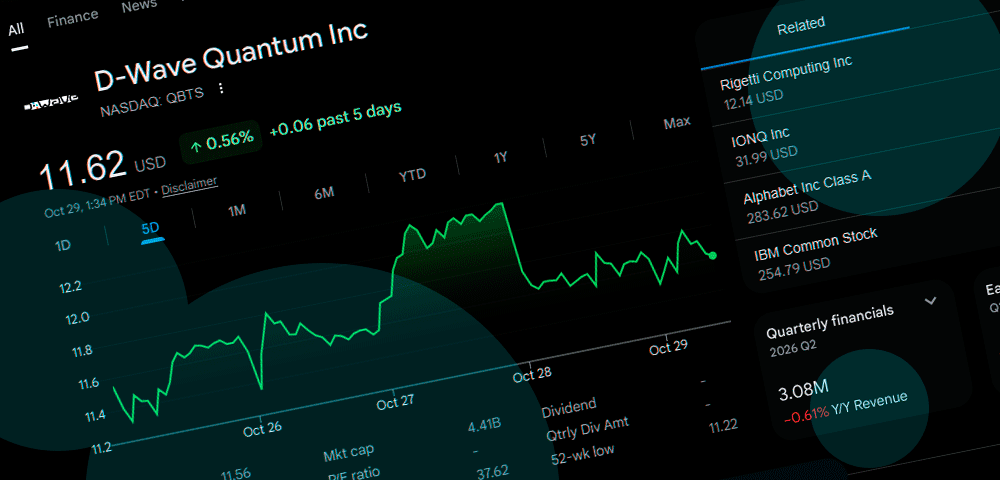
The stock closed at $11.77 on October 28, 2026, and traded around $11.60 during the following session, near its 52-week low. Analysts’ medium-term forecasts remain substantially above prevailing market prices, reflecting expectations that commercial quantum computing adoption will accelerate.
- Wall Street remains predominantly bullish on D-Wave Quantum, with the leading analyst consensus implying approximately 194% upside from the October 28 closing price, despite the stock’s prolonged decline.
- Revenue forecasts depend heavily on major quantum-system deliveries during the final quarter of 2026. Recent financial results show substantial differences between customer bookings, recognized revenue and operating expenditure.
- D-Wave’s collaboration with Shionogi provides additional evidence of potential commercial applications for quantum computing, but high valuation multiples, continuing losses and securities litigation remain significant risks.
The central issue for investors is whether D-Wave can convert its expanding order book and technological capabilities into the revenue growth required to support its valuation.
D-Wave Quantum Stock Price Forecast: Analyst Consensus
According to S&P Global Market Intelligence, 17 analysts covering D-Wave have an average 12-month price target of $34.65, with a median estimate of $36. The highest forecast is $43, while the lowest stands at $18.36.
The consensus classification is Strong Buy, comprising 15 positive recommendations and two Hold ratings.
MarketBeat reports a somewhat higher average target of $36.27 across 16 brokerages, with 13 Buy recommendations, two Holds and one Sell. Differences in analyst coverage and rating classifications explain why the two services produce different results.
These forecasts should not be interpreted as independent confirmation that the shares are undervalued. Several brokerage targets were established before the stock’s latest decline, meaning their implied upside increased as the market price fell, without corresponding upward revisions to analysts’ expectations.
The wide dispersion of forecasts also reflects uncertainty about the timing of quantum computing commercialization, future profitability and the valuation investors will assign to an emerging technology business.
Latest Wall Street Price Targets and Investment Bank Revisions
Rosenblatt Securities remains among D-Wave’s most optimistic institutional research firms. Analyst John McPeake maintained a Buy rating and $43 target in August, reflecting expectations that the company can expand its existing quantum annealing business while developing competitive gate-model computing technology.
A substantial group of brokerages has targets of $40, including B. Riley Securities, Jefferies, Wedbush, Cantor Fitzgerald, Needham and Craig-Hallum.
B. Riley analyst Craig Ellis reiterated the firm’s Buy recommendation on September 21, one of the latest identifiable brokerage updates. The firm previously raised its target following D-Wave’s June investor day, citing its extended gate-model development roadmap and commercial opportunities. Its subsequent research also highlighted the possibility of greater U.S. government support for commercial quantum computing.
Evercore ISI has a $37 target, while BMO Capital Markets, Canaccord Genuity and Stifel are grouped at $35. More conservative valuations include Roth Capital and Benchmark at $30, Mizuho Securities at $29 and Northland Securities at $22. Northland maintains a Hold recommendation, while the other firms retain positive ratings.
The August earnings report nevertheless prompted several downward revisions.
Jefferies reduced its previous target by $5 after D-Wave missed quarterly revenue expectations. The firm retained its Buy recommendation, anticipating a substantial fourth-quarter improvement associated with two expected quantum-system deliveries.
Canaccord lowered its objective by $6, acknowledging technological and commercial progress while noting that reported revenue and bookings indicated more modest near-term growth.
Roth Capital made a larger $10 reduction, primarily reflecting market valuation considerations. Analyst Suji Desilva nevertheless identified improving quantum-computing-as-a-service demand and an expanding system sales pipeline.
Mizuho reversed its June target increase with a $6 reduction in August. Analyst Vijay Rakesh maintained an Outperform rating, citing the company’s differentiated combination of annealing and gate-model technologies while adjusting financial expectations.
The revisions highlight an important distinction in Wall Street’s assessment of D-Wave. Analysts generally remain constructive about its technological position, but their valuations increasingly depend on the timing of commercial adoption and the premium investors are willing to pay for expected future growth.
Second-Quarter Earnings Expose the Revenue Gap
D-Wave’s second-quarter results, released August 6, demonstrated the uneven financial performance underlying its bullish stock forecasts.
Revenue totaled $3.08 mn for the three months ended June 30, compared with approximately $3.10 mn a year earlier. The result missed the market’s revenue estimate by nearly 24%.
GAAP gross margin declined to 55.4% from 63.8%, while operating expenses increased 93% to $55.0 mn, reflecting investment in research, personnel, product development and commercialization.
The company reported a net loss of $48.0 mn, equivalent to $0.13 per share. Although substantially narrower than the previous year’s GAAP loss, the improvement primarily reflected the absence of large noncash warrant-related charges recorded in 2025.
Adjusted EBITDA losses widened to $37.1 mn from $20.0 mn, providing a less favorable measure of underlying operating performance. The stock declined 9.28% following the earnings announcement, closing at $19.41.
Customer demand indicators presented a stronger picture than recognized sales.
Second-quarter bookings increased 59% year over year to $2.1 mn, although they fell sharply from the preceding quarter. For the first six months of 2026, bookings reached $35.5 mn, representing growth of 1,120% over the comparable period.
That first-half total included a $20 mn quantum computing system sale whose revenue was expected to be recognized in subsequent quarters.
Remaining performance obligations reached $40.7 mn at June 30, an increase of 668% year over year. Management expected approximately 57% of those contracted obligations to become recognized revenue over the following 12 months.
There were also signs of greater commercial use of D-Wave’s cloud services. Production applications generated $1.3 mn in quantum-computing-as-a-service revenue during the first half, representing 37.3% of that business’s revenue, compared with 9.8% a year earlier.
The figures suggest growing customer engagement, but bookings and contracted obligations do not immediately generate revenue or cash flow. Hardware delivery schedules and customer acceptance remain particularly important because individual system sales can materially affect quarterly results.
Revenue Forecasts Require a Sharp Fourth-Quarter Acceleration
Analyst consensus estimates project approximately $42.47 mn in revenue for 2026, compared with the $24.59 mn reported in 2025. Expectations for 2027 indicate a further increase to about $80.61 mn.
Reaching those forecasts requires a substantial acceleration from D-Wave’s recent financial performance.
First-half revenue was only $5.93 mn, down 67% year over year. The comparison was affected by a $13.7 mn system sale recognized in the first half of 2025, demonstrating the importance of large hardware contracts to reported growth.
To achieve the current full-year consensus, D-Wave would need approximately $36.5 mn in second-half revenue, more than six times its first-half total.
With third-quarter market expectations around $4.3 mn, the implied fourth-quarter requirement approaches $32.2 mn.
That would represent an exceptionally large increase from recent quarterly sales. Anticipated system deliveries could contribute substantially, but the timing of revenue recognition remains uncertain.
Consequently, the company’s near-term financial outlook depends less on gradual growth in existing service revenue than on successful execution of major equipment contracts.
This creates the possibility of significant earnings surprises in either direction. Delayed deliveries could produce another revenue miss without necessarily indicating that contracts have been canceled, while successful recognition of large system sales could generate unusually strong quarterly growth.
The distinction matters when assessing annual forecasts and comparing D-Wave with companies whose revenue is more evenly distributed across reporting periods.
Is D-Wave Quantum Stock Overvalued?
D-Wave’s valuation remains demanding even after the decline in its share price.
At an equity market capitalization of approximately $4.3 bn during October 29 trading and trailing 12-month revenue of $12.43 mn, the company trades at roughly 350 times historical sales.
Using forward consensus estimates reduces the multiple substantially, but still produces a valuation exceeding 100 times expected 2026 revenue and more than 50 times projected 2027 sales.
These are equity market capitalization-to-revenue ratios rather than enterprise-value multiples. Nevertheless, they demonstrate how strongly the stock’s valuation depends on future commercial expansion.
The more optimistic brokerage targets would imply an equity capitalization of approximately $15 bn to $16 bn using roughly 372 million shares outstanding.
Those valuations require investors to attribute considerable value to D-Wave’s intellectual property, technological roadmap and ability to capture a meaningful share of the emerging quantum computing market.
BMO Capital Markets illustrates the assumptions behind such forecasts.
Analyst Harsh Kumar initiated coverage in August with an Outperform recommendation, emphasizing D-Wave’s acquisition of Quantum Circuits and the potential advantages of its dual-rail gate-model architecture.
The bank forecast revenue of approximately $34 mn in 2026 and $71 mn in 2027, with its target valuation representing roughly 180 times projected 2027 sales.
BMO’s assumptions included the possibility of selling two to three quantum systems annually beginning in 2027, alongside broader commercialization of cloud services and gate-model technology.
However, the bank also projected negative free cash flow of approximately $161 mn in 2026 and $147 mn in 2027. Its model therefore anticipates continued substantial investment before the company approaches financial sustainability.
D-Wave’s balance sheet provides some protection against those requirements. At June 30, cash and marketable investment securities totaled $546.2 mn, while operating activities had consumed $73.5 mn during the first half.
The liquidity position supports continued development, but it does not eliminate execution risk. Sustained operating losses, larger-than-expected research spending or slower commercialization could increase future financing requirements.
Quantum Annealing and Gate-Model Computing Drive Growth Expectations
D-Wave’s investment case centers on two distinct quantum computing technologies. Its established annealing systems are designed to address complex optimization problems, including scheduling, logistics and resource allocation. Customers can access the technology through dedicated systems or the company’s Leap cloud platform, supported by its Ocean software development tools.
The January acquisition of Quantum Circuits expanded D-Wave’s capabilities into gate-model computing, which targets a broader range of computational applications.
The acquired dual-rail architecture is designed to improve error detection, potentially reducing some of the technical challenges associated with developing fault-tolerant quantum computers.
D-Wave’s published roadmap includes progressively larger physical-qubit systems and a target of developing a 10-logical-qubit system capable of supporting initial fault-tolerant algorithms by 2030.
These milestones could expand the company’s addressable market, but they remain development objectives rather than guaranteed commercial achievements.
The two platforms also have different maturity profiles. Annealing technology already generates commercial revenue, while gate-model computing requires further engineering progress and investment before it can contribute at a comparable scale.
The financial significance of the strategy will ultimately depend on whether D-Wave can translate technical performance improvements into customer deployments, recurring service revenue and profitable system sales.
Shionogi Drug Discovery Research Demonstrates a New Application
D-Wave announced on October 28 that Japanese pharmaceutical company Shionogi had won first place in the Quality of Life category of the NEDO quantum computing challenge.
The award recognized research into quantum-assisted drug discovery, including a peer-reviewed study published in Scientific Reports in July 2026.
Researchers integrated D-Wave’s annealing technology into a generative AI model designed to produce molecular candidates.
The quantum-assisted approach generated chemically valid molecular representations in 97% of cases, compared with 73% using an equivalent classical model. It also produced a higher proportion of molecules with strong drug-likeness characteristics than both the classical comparison model and the original training dataset.
The findings suggest that quantum annealing could help improve molecular design during early-stage pharmaceutical research, potentially broadening the applications of D-Wave’s existing technology.
Shionogi received a ¥40 mn prize to support continued research. The award was not revenue granted to D-Wave, and the announcement did not establish that the collaboration would generate additional commercial sales.
The study also did not demonstrate improvements in clinical trial success, drug approval rates or the time required to develop approved medicines.
Its immediate significance is therefore technological. It provides evidence of a potentially useful application, but further commercial contracts would be necessary to establish its financial contribution.
Securities Litigation and Management Changes Add Uncertainty
D-Wave faces a securities class action filed October 15, 2026, in the U.S. District Court for the Northern District of California.
The lawsuit, Fessler v. D-Wave Quantum, Inc. et al., concerns investors who acquired company securities between February 26 and August 25.
The complaint alleges that D-Wave and certain executives made materially misleading statements or failed to disclose information concerning the company’s business and financial prospects.
Specifically, the plaintiffs allege that the defendants overstated D-Wave’s commercial outlook and that some positive statements lacked a reasonable basis.
These allegations have not been established by a court. The filing of a securities complaint does not itself demonstrate wrongdoing.
The deadline for investors seeking appointment as lead plaintiff is December 15, 2026.
The litigation follows a period of heightened market volatility, including a second substantial share-price decline after the company announced the retirement of Chief Financial Officer John Markovich.
Shares fell 9.51% to $17.51 on August 26 following that announcement.
D-Wave disclosed that Markovich’s departure, effective September 2, did not result from disagreements over accounting practices, financial reporting or internal controls. Senior Vice President of Finance Greg Golkov became acting CFO.
The transition and pending litigation create additional uncertainty for investors already assessing substantial operational and valuation risks.
November Earnings Will Test Wall Street’s Forecasts
D-Wave is scheduled to report third-quarter 2026 financial results on November 10, before the U.S. market opens.
The release will provide a clearer assessment of whether the company’s expanding commercial pipeline is translating into recognized sales.
Investors will be watching system delivery schedules, changes in bookings and remaining performance obligations, recurring cloud-service revenue, operating expenditure and liquidity.
The report will also provide an opportunity to evaluate management’s expectations for the December quarter, when analysts anticipate a substantial contribution from major hardware contracts.
A stronger-than-expected revenue outlook supported by confirmed deliveries could strengthen confidence in existing brokerage forecasts. Further delays or weaker customer demand would increase the pressure on estimates and valuation multiples.
With reported profitability still distant, the decisive financial question is whether D-Wave can deliver the rapid revenue acceleration embedded in analysts’ models.
The November results will provide the next measurable indication of whether those expectations remain achievable.