Overview
Goldman Sachs Group (NYSE: GS) shares rose on October 13, 2026, after the investment bank reported stronger-than-expected third-quarter earnings, driven by a sharp increase in equities trading and continued investment banking activity.
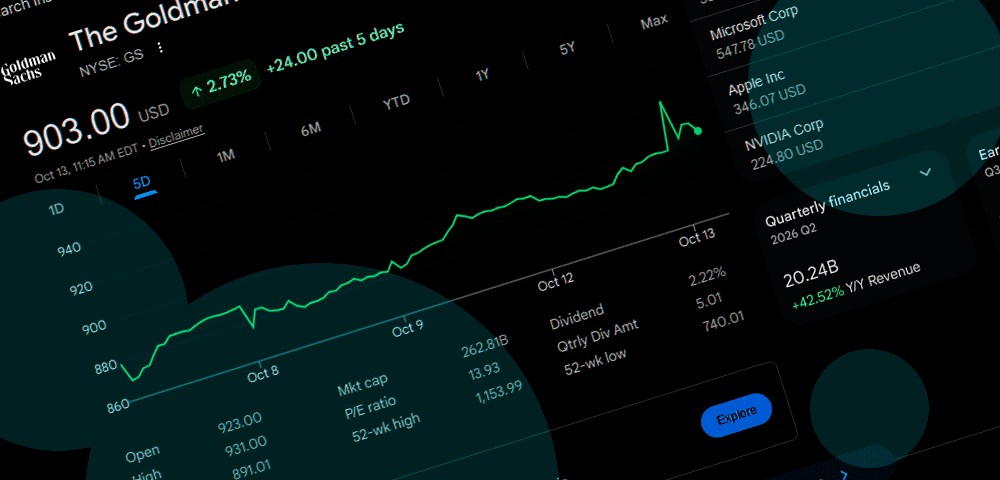
The stock traded around $902 at 11:13 a.m. Eastern, compared with Monday’s closing price of $893.95. Shares had climbed as much as 3.6% in early trading before paring their gains.
- Goldman Sachs reported Q3 2026 earnings of $17.01 per share, exceeding the $13.02 LSEG consensus. Net income rose 29% to $5.29 bn, while revenue increased 23% to $18.68 bn.
- Equities trading revenue jumped 72% to $6.44 bn, helping offset weaker fixed-income performance. FICC revenue declined 24% sequentially to $3.47 bn, reflecting softer activity in credit, mortgages and rates.
- Goldman Sachs shares traded at approximately $902 on October 13, up 0.9% at 11:13 a.m. ET. The average 12-month analyst price target was $1,055, implying nearly 17% potential upside, although the consensus rating remained Hold.
Goldman reported quarterly net revenue of $18.68 bn, up 23% year over year and above the $16.83 bn FactSet consensus. Net earnings increased 29% to $5.29 bn, while diluted earnings per share rose 39% to $17.01, exceeding analysts’ expectations.
The results were strong, but performance across the bank’s trading businesses was uneven.
Goldman Sachs equities revenue jumps 72%, while bond trading weakens
Equities trading generated $6.44 bn in third-quarter revenue, an increase of 72% from a year earlier. Growth came from derivatives trading, prime financing and portfolio financing as institutional investors adjusted their positions amid volatile markets.
The figure exceeded Wall Street’s forecasts, although it was 13% below the record $7.42 bn reported in the second quarter.
Fixed Income, Currency and Commodities (FICC) revenue presented a different picture. Revenue declined 1% year over year and 24% sequentially to $3.47 bn, with weaker performance in mortgage products, credit and interest-rate trading.
Investment banking provided another source of growth. Fees increased 21% to $3.22 bn, supported by advisory mandates and underwriting activity. Advisory revenue reached $1.65 bn, while equity underwriting revenue increased 43% to $666 mn.
Nevertheless, investment banking fees declined 5% from the second quarter, and Goldman reported a smaller deal-fee backlog than three months earlier.
Asset and Wealth Management revenue increased 14% to $5.05 bn, supported by higher management and incentive fees. This business provides a recurring fee base that can partially offset fluctuations in trading income.
For the first nine months of 2026, Goldman generated record net revenue of $56.24 bn and diluted EPS of $55.56, up 49% from the corresponding period last year.
Goldman Sachs stock valuation and analyst price targets
At approximately $902 per share, Goldman trades at roughly 2.4 times its September 30 book value of $372.64 per share. That valuation is supported by substantial profitability. The bank reported annualized return on common equity of 18.7% in the third quarter and 20.7% for the first nine months.
Capital distributions also remain significant. Goldman returned $4.49 bn to common shareholders during the quarter through dividends and repurchases. Its board declared another quarterly dividend of $5 per share, payable December 30.
Wall Street’s price forecasts indicate potential appreciation, although analysts remain divided.
MarketBeat’s consensus of 24 analysts places the average 12-month Goldman Sachs stock price target at $1,055.09, approximately 17% above the October 13 intraday price. The targets range from $920 to $1,300.
Ten analysts have positive ratings, 13 recommend holding the stock and one has a sell recommendation.
Recent target revisions show why expectations differ. UBS reduced its target from $1,150 to $1,010 on October 5, while BMO Capital Markets lowered its forecast to $970 on October 6. Wells Fargo maintained a more optimistic outlook with a $1,175 target following a September reduction.
These forecasts largely predate the latest earnings release and may change as analysts incorporate the third-quarter results.
Goldman Sachs stock forecast: What could drive GS shares in 2027?
The earnings report supports Goldman’s investment outlook, but maintaining current profitability will depend on the strength of its trading franchise and investment banking activity.
The positive case rests on continued institutional trading demand, recovery in capital markets transactions and further growth in asset management fees. Sustained returns on equity near current levels would also support the stock’s valuation.
The main risk is that the exceptional performance of equities trading proves difficult to repeat. Fixed-income revenue has already weakened, while higher interest rates and geopolitical uncertainty could constrain future underwriting and advisory activity.
Goldman’s total quarterly revenue also fell 8% from the second quarter, demonstrating that strong annual comparisons do not necessarily translate into consistent sequential growth.
The approximately $1,055 consensus target provides a reference point for the next 12 months, rather than a guaranteed price outcome. The bank’s ability to sustain elevated returns on equity and generate more consistent earnings across its businesses will determine whether shares can move toward analysts’ higher forecasts.