Overview
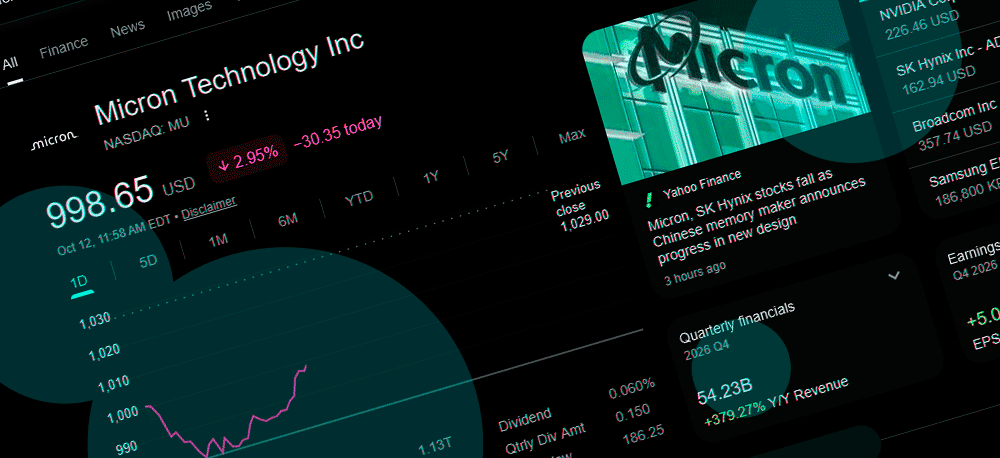
Micron Technology (NASDAQ: MU) shares declined on October 12, 2026, after Chinese semiconductor manufacturer ChangXin Memory Technologies (CXMT) announced progress in next-generation memory technology, raising concerns about competition in the global DRAM market.
Micron fell approximately 3%–4% during Monday’s session, trading near $990–$1,000. The decline extended a broader retreat in memory stocks, with SK Hynix and Samsung Electronics also losing ground.
- Micron Technology (NASDAQ: MU) shares fell approximately 3%–4% on October 12, trading around $990–$1,000 as China’s ChangXin Memory Technologies (CXMT) announced progress in high-density DRAM technology.
- Wall Street’s average 12-month Micron price target is approximately $1,555, while D.A. Davidson raised its bullish forecast to $3,000. Micron’s fiscal Q4 2026 revenue reached a record $54.23 bn.
- Micron expects fiscal Q1 2027 revenue of $61.5 bn and has expanded its share repurchase authorization to $35.16 bn, although Chinese competition and future memory pricing remain important risks.
Despite the selloff, Micron remains one of the strongest-performing semiconductor stocks of 2026, having gained more than 260% earlier in the year. Demand for artificial intelligence infrastructure, higher memory prices and exceptional earnings growth have supported the rally.
The latest developments raise a question for investors: whether Micron’s earnings expansion can continue long enough to justify Wall Street’s increasingly ambitious stock price forecasts.
Micron stock price targets: Wall Street sees further upside
According to analyst estimates compiled by S&P Global, Micron has an average 12-month price target of approximately $1,555, with a median target of $1,550. Based on a share price near $999, the consensus implies potential appreciation of roughly 56%.
Analyst forecasts vary considerably, with targets ranging from $361 to $3,000. Of the 49 analysts included in the consensus, 45 recommend buying or strongly buying the stock.
On October 7, D.A. Davidson analyst Gil Luria increased his price target from $2,100 to $3,000, maintaining a Buy recommendation.
Luria’s valuation assumes Micron could trade at approximately 19 times projected fiscal 2027 earnings, rather than the roughly six times forward earnings reflected in his analysis.
Other forecasts are more conservative. UBS maintains a $1,625 target, Needham projects $1,650, while Goldman Sachs has established a $1,250 target.
These estimates reflect different assumptions about future memory prices, earnings sustainability and valuation multiples. The $3,000 forecast is an especially optimistic scenario, rather than a consensus expectation.
Micron reports record earnings as AI memory demand accelerates
Micron’s September 30 earnings release demonstrated the scale of its recent financial expansion.
Fiscal fourth-quarter revenue reached $54.23 bn, compared with $11.32 bn a year earlier. Non-GAAP net income increased to $38.40 bn, equivalent to $33.42 per diluted share.
For fiscal 2026, revenue totaled $133.19 bn, up from $37.38 bn in the preceding year. Adjusted diluted earnings reached $75.52 per share.
The company expects fiscal first-quarter 2027 revenue of $61.5 bn, plus or minus $1.5 bn, with adjusted earnings of approximately $38.15 per share.
Demand for high-bandwidth memory (HBM), advanced DRAM and server memory remains central to this outlook. Micron has already begun high-volume shipments of HBM4 and is developing HBM4E products for expected volume production in calendar 2027.
The company is also expanding its shareholder return program. On October 8, its board authorized additional share repurchases, bringing available authorization to $35.16 bn for purchases beginning December 9, subject to applicable restrictions and market conditions.
Actual repurchases will depend on management’s capital allocation decisions and are not guaranteed.
China’s CXMT introduces new competition in DRAM technology
The immediate pressure on Micron shares followed CXMT’s announcement of progress in a 4F² memory-cell architecture. Unlike the conventional 6F² structure widely used in commercial DRAM, the newer design reduces the area occupied by individual memory cells, potentially increasing storage density and manufacturing efficiency.
CXMT developed a proprietary Vertical Surrounding Gate (VSG) transistor intended to reduce current leakage while supporting a more compact cell structure.
The company plans to introduce DDR5 registered memory modules for enterprise servers using the technology before the end of 2026.
CXMT’s fifth-generation DRAM manufacturing platform, G5, also entered mass production in September. These advances could strengthen Chinese competition in conventional server memory, where Micron, SK Hynix and Samsung remain established suppliers.
However, CXMT has not disclosed detailed specifications, production yields or shipment volumes for its new 4F² product. Its announcement therefore does not establish that the company can immediately compete at scale with leading international manufacturers.
SK Hynix has already outlined its own 4F² development plans, while Samsung reportedly targets production using the architecture by 2028.
Micron stock outlook: Earnings growth versus pricing risks
Micron’s near-term financial position remains strong. Record revenue, substantial cash generation and customer commitments provide support for its fiscal 2027 outlook. The principal risk is whether today’s unusually favorable memory pricing conditions can persist.
Additional DRAM manufacturing capacity, particularly from Chinese competitors, could eventually put pressure on selling prices and margins. Memory manufacturers have historically experienced substantial earnings volatility as supply and demand move through industry cycles.
A second concern is valuation. Micron’s relatively low forward earnings multiple depends on forecasts of exceptionally high profitability. A decline in memory prices could reduce expected earnings and make the stock more expensive than current forward ratios suggest.
CXMT’s technological progress does not immediately undermine Micron’s position in advanced AI memory, but it introduces another competitive factor into longer-term forecasts.
At approximately $1,000 per share, Micron trades substantially below the $1,555 analyst consensus target. Reaching that level will depend on sustained AI infrastructure spending, successful execution of its HBM product strategy and continued strength in DRAM pricing.
The next quarterly results will provide a clearer indication of whether revenue can reach management’s $61.5 bn forecast and whether the company can maintain the exceptional profit margins achieved in fiscal 2026.