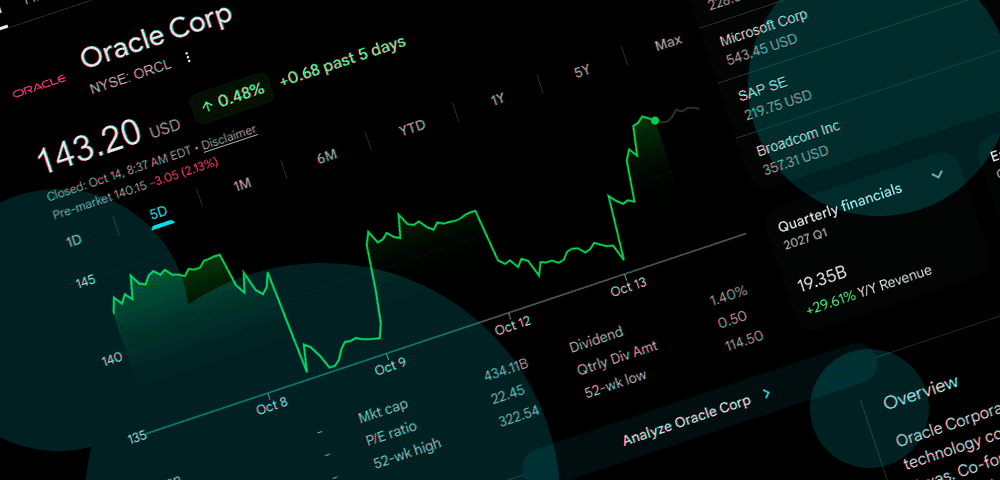
Oracle Corporation (NYSE: ORCL) shares rebounded 4.23% to $143.20, recovering part of their recent losses as investors reassessed the company’s artificial intelligence infrastructure business and substantial financing requirements.
The stock gained $5.81 during the session, with approximately 26.3 mn shares traded. Despite the advance, Oracle remains below its 50-day moving average, suggesting that the recovery has not yet established a sustained upward trend.
As of October 14, Wall Street analysts remain predominantly positive on Oracle’s longer-term prospects, although forecasts vary considerably.
- Oracle shares closed at $143.20 on October 13, 2026, gaining 4.23%. Wall Street’s average 12-month price target stands at $237.97, implying approximately 66% potential upside.
- Oracle reported fiscal Q1 2027 revenue of $19.3 bn, up 30%, while cloud infrastructure revenue surged 121% to $7.4 bn. Its remaining performance obligations reached $664 bn.
- Data center delays, $125.3 bn in outstanding borrowings and negative free cash flow remain major risks. Technically, ORCL faces resistance at $150.59 and support at $132.60.
According to S&P Global Market Intelligence data covering 43 analysts, Oracle has a consensus Buy rating and an average 12-month price target of $237.97. That represents approximately 66.2% upside from the October 13 closing price.
A separate MarketBeat aggregation of 47 analysts produces a higher consensus target of $251.72, implying 75.8% potential appreciation. The difference reflects variations in analyst coverage and calculation methods.
The most optimistic forecast reaches $400, while the lowest stands at $110.
Oracle stock price targets from leading Wall Street analysts
Several major investment banks maintain positive recommendations despite concerns about Oracle’s expanding debt obligations and capital spending.
- Goldman Sachs has a Buy rating and a $240 price target, revised upward from $239 in September.
- UBS maintains a Buy recommendation with a $250 target, while Barclays has an Overweight rating and a $252 forecast.
- Morgan Stanley has a more cautious Equal Weight rating and a $210 target.
- Jefferies maintains its Buy recommendation with a $290 target, reduced from $320. Bernstein has a $325 target, while Guggenheim’s $400 forecast is among the most optimistic on Wall Street.
- RBC Capital Markets has a Sector Perform rating and a $165 target, reflecting a more conservative assessment of the company’s valuation and financial risks.
Recent analyst forecasts therefore indicate substantial potential appreciation, but the gap between individual targets reflects uncertainty about how quickly Oracle can turn its AI contracts into profitable revenue.
Oracle’s AI cloud revenue grows 121% as backlog reaches $664 bn
Oracle’s latest quarterly results demonstrate accelerating demand for cloud infrastructure. For the first quarter of fiscal 2027, ended August 31, 2026, total revenue increased 30% year over year to $19.3 bn.
Cloud revenue climbed 62% to $11.6 bn, including a 121% increase in infrastructure-as-a-service revenue to $7.4 bn. Cloud applications revenue grew 10% to $4.2 bn. GAAP earnings per share increased 55% to $1.56, while adjusted EPS rose 30% to $1.92.
The company’s remaining performance obligations (RPO) reached $664 bn, following more than $30 bn in additional AI cloud contracts booked during the quarter.
RPO represents contracted revenue not yet recognized and provides visibility into future business. It does not guarantee immediate cash generation, particularly when customers require new data centers and computing infrastructure before services can begin.
Oracle expects fiscal 2027 revenue of at least $90 bn and adjusted EPS of $8.10. Analyst consensus estimates are slightly higher, projecting approximately $90.42 bn in annual revenue and $8.14 in adjusted EPS.
For fiscal 2028, analysts forecast revenue of approximately $131.71 bn and adjusted EPS of $11.00, suggesting that substantial growth expectations extend beyond the current year.
Data center delays and $125 bn debt create financial pressure
Oracle’s investment program remains the principal concern for credit investors. The company reported approximately $125.3 bn in outstanding borrowings as of August 31, against $37.1 bn in cash, cash equivalents and marketable securities.
Capital expenditures reached $28.5 bn during fiscal Q1 2027, contributing to negative free cash flow of $5.4 bn. Operating cash flow totaled $23.1 bn, although this included approximately $11.4 bn in customer prepayments with a significant financing component.
Oracle also completed a $20 bn equity issuance during the quarter to support its infrastructure investment program.
Credit markets have responded to the increasing financing requirements. On October 8, Oracle’s five-year credit default swap spread reached 261 basis points, reflecting higher costs for investors seeking protection against potential default.
Morgan Stanley credit analysts have also raised concerns about potential delays in large AI data center developments.
Oracle’s Project Lighthouse in Wisconsin faces electricity transmission approval challenges that could delay meaningful operations into 2028.
Project Jupiter in New Mexico has encountered separate power infrastructure issues, including uncertainty surrounding natural gas supplies.
On October 13, Oracle announced a proposed agreement with El Paso Electric involving at least $100 mn in electricity payments over 10 years and potential customer credits of up to $165 mn over three years.
The arrangement is intended to support the development of Project Jupiter while addressing local electricity costs. Oracle maintains that the project’s primary power source will remain a Bloom Energy fuel-cell microgrid.
Delays in delivering computing capacity could postpone revenue recognition while financing expenses and infrastructure commitments continue.
Oracle stock forecast: What could drive the next move?
Oracle’s outlook depends on whether strong AI cloud demand can produce sufficient cash flow to support its infrastructure expansion.
The $664 bn RPO backlog and 121% cloud infrastructure growth support analysts’ positive earnings forecasts. Yet the company’s negative free cash flow, financing requirements and possible data center delays complicate its valuation.
At $143.20, Oracle trades at approximately 17.6 times consensus adjusted fiscal 2027 earnings, compared with about 13 times projected fiscal 2028 earnings.
Those multiples assume that analysts’ profit forecasts are achieved. Delays in cloud capacity deployment or weaker profitability could materially change the valuation.
In the near term, a sustained move above $150.59 would support further recovery. The more consequential financial test is whether Oracle can translate its contracted AI demand into recognized revenue and improve cash generation without requiring substantially more external financing.