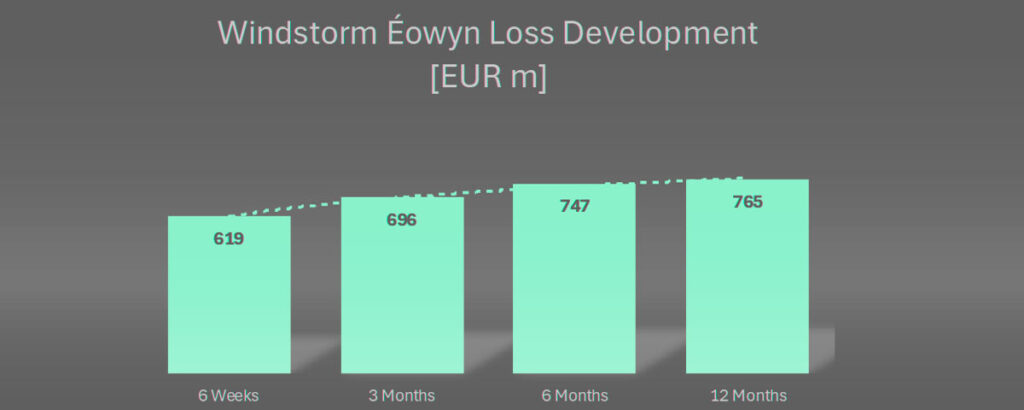
PERILS, a Zurich-based organization that provides industry-wide catastrophe loss data for the insurance and reinsurance markets, has released its fourth and final industry loss estimate for Windstorm Éowyn, which hit the British Isles on 24–25 January 2025, putting total insured losses at EUR 765 mn.
The final figure edges above earlier estimates of EUR 747 mn, EUR 696 mn, and EUR 619 mn published six months, three months, and six weeks after the event.
The estimate covers property lines only and is based on claims data submitted by affected insurers.
Three months after landfall, industry losses had already reached about 91% of the final total, pointing to limited late development. According to PERILS, that pattern reflects relatively stable loss emergence despite the storm’s unusual intensity.
The final report breaks down property losses by country and by CRESTA zone, using UK area codes and Irish counties, with further splits between personal and commercial property lines.
Combined with PERILS’ industry exposure database and high-resolution wind data, the footprint offers a detailed view of wind vulnerability across insured property in the UK and Ireland.
Windstorm Éowyn delivered hurricane-force gusts across the Republic of Ireland, Northern Ireland, and central Scotland. In Ireland, gusts reached up to 185 km/h, setting new records.
The storm caused widespread disruption. Around 1.8 mn premises lost power, more than 1.4 mn people experienced mobile network outages, and extensive physical damage followed, including uprooted trees, overturned trucks, and roofs torn from buildings. Two fatalities were reported.
- Ireland bore the heaviest insurance impact. Losses there reached EUR 316 mn, marking the largest windstorm loss for the Irish market in at least 45 years.
- In the UK, insured losses totaled GBP 378 mn, a level seen or exceeded twice over the past two decades.
Luzi Hitz, product manager at PERILS, said the stability of the estimates over a 12-month period stands out given the storm’s rarity. He noted that early loss projections often rely on analogues from past events, which becomes difficult when wind speeds exceed historical experience.
24% increase from the six-week estimate to the final figure, and the roughly 10% rise between the three-month and one-year marks, represent modest development by industry standards.
In his view, that points to mature catastrophe loss estimation practices in both the UK and Irish markets.
Hitz added that Éowyn carries lasting value from a modelling perspective. The storm produced extreme wind speeds with minimal water-related damage, creating a clean dataset for calibrating vulnerability functions at gust levels where empirical data remains scarce.