US technology stocks face a more uncertain outlook after a sharp selloff erased more than $1 tn in market value on October 16, 2026, as rising oil prices, higher borrowing costs and concerns about artificial intelligence spending prompted investors to reduce exposure.
The Nasdaq-100 declined 2.5%, leaving the index approximately 7% below its recent record. The Nasdaq Composite fell 2.14% to 26,140.03 and lost 4.5% over the week, its worst weekly performance since June.
- US technology stocks erased more than $1 tn in market value on October 16. The Nasdaq-100 fell 2.5%, while the Nasdaq Composite lost 4.5% over the week.
- UBS maintains a positive AI sector outlook, forecasting $900 bn in AI-related spending in 2026. RBC Capital Markets downgraded technology to Market Weight, while Deutsche Bank warned about near-term valuations.
- Microsoft remains a preferred technology stock among several banks. UBS raised its price target to $675, Jefferies to $650 and Citigroup to $636, despite broader selling pressure.
The Philadelphia Semiconductor Index recorded eight consecutive sessions of losses, its longest losing streak since 2008. Micron Technology declined 5.6%, Advanced Micro Devices fell 6%, Broadcom lost 4.5% and Intel dropped 5.8% during Friday’s session.
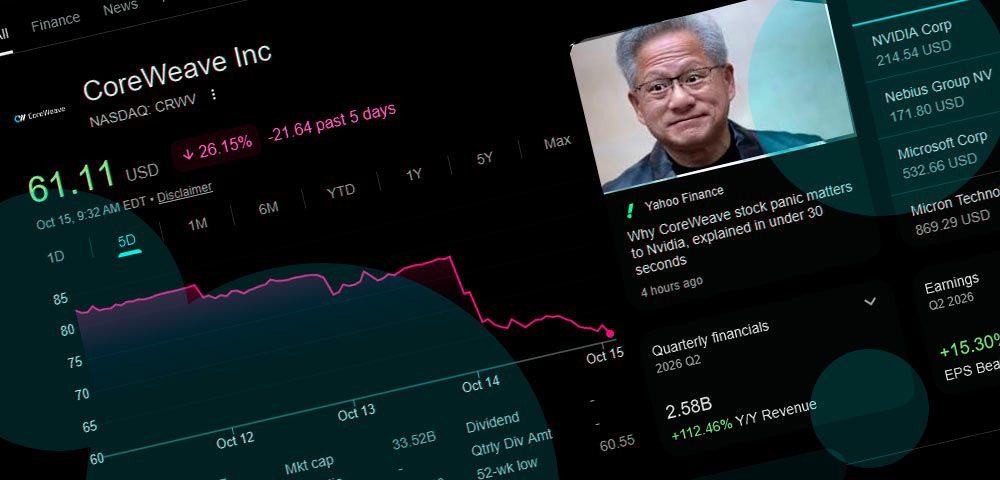
The selloff also affected AI software and infrastructure companies. CoreWeave shares declined 11.9% to $61.39, extending their five-session loss to approximately 25%.
Wall Street analysts differ on technology stock outlook
UBS Global Wealth Management remains constructive on AI-related equities despite the correction.
In its October 14 research, the bank characterized the semiconductor selloff as a reassessment of earnings expectations rather than evidence of deteriorating AI demand.
- UBS forecasts approximately $900 bn in AI-related spending during 2026 and expects cloud revenue growth of 58% year over year in the September quarter, up from 48% in the previous quarter. The bank projects third-quarter S&P 500 earnings growth of approximately 28%, with semiconductor companies contributing substantially to the increase.
- UBS favors diversified AI exposure, particularly semiconductor equipment manufacturers, cloud platforms and selected technology businesses with established earnings. RBC Capital Markets has adopted a more cautious position.
- Lori Calvasina, head of US equity strategy at RBC, downgraded the technology sector from Overweight to Market Weight in October, citing less attractive valuations, weakening fund flows and slower upward earnings revisions among semiconductor companies.
- Deutsche Bank also reduced its near-term enthusiasm for technology stocks. In an October 9 assessment, the bank argued that the sector’s recent outperformance had reduced its risk-adjusted return potential.
- Goldman Sachs data provides further evidence of changing institutional positioning. Its prime brokerage unit reported that fundamental long-short hedge funds lost 2.9% during the week through October 15 as investors unwound crowded AI positions.
Microsoft remains a leading technology stock among analysts
Several major investment banks continue to favor Microsoft (NASDAQ: MSFT), citing Azure cloud growth, enterprise AI adoption and recurring software revenue.
Recent 12-month Microsoft stock price targets include:
- UBS: $675, Buy
- Jefferies: $650, Buy
- Citigroup: $636, Buy
- TD Cowen: $625, Buy
- Mizuho: $600, Outperform
Microsoft closed October 16 at $529.05. The UBS target implies approximately 27.6% upside, while Jefferies’ forecast suggests 22.9%.
UBS analyst Karl Keirstead raised Microsoft’s target from $525 to $675, arguing that stronger Azure and Microsoft 365 fundamentals support higher earnings expectations.
These forecasts reflect confidence in Microsoft’s capacity to convert AI infrastructure spending into commercial revenue, although the company’s substantial capital expenditure remains an important consideration.
Oil prices and interest rates pressure technology valuations
The deterioration in technology stocks coincided with another increase in energy prices.
Brent crude closed October 16 at $109.86 per barrel, its highest closing level since May 19. West Texas Intermediate reached $101.41, rising 3.5% during Friday’s session.
Elevated energy prices have increased inflation concerns and strengthened expectations that the Federal Reserve could raise interest rates again.
The yield on the 10-year US Treasury remained near 5.1%, making long-duration growth equities more sensitive to changes in discount rates.
Barclays now expects 25-basis-point Federal Reserve rate increases in December 2026 and January 2027. That remains a bank forecast rather than a confirmed policy decision.
Higher financing costs are particularly challenging for companies relying on debt to expand AI infrastructure.
CoreWeave’s unsecured bond yields exceeded 15% during the week, reflecting concerns about the cost of financing new data centers and the timing of returns on those investments.
By comparison, established technology companies with recurring revenues and substantial cash generation are less directly dependent on external financing.
Tech stock forecast for late 2026 and 2027
Technology earnings will become increasingly important as investors reassess valuations.
According to Goldman Sachs estimates cited by Reuters, five major AI hyperscalers could increase combined capital expenditure to approximately $1.2 trillion in 2027.
The central question is whether earnings and cash flow can grow sufficiently to justify that investment.
Results from Meta Platforms, Tesla, Lam Research and Texas Instruments will provide near-term evidence of cloud demand, semiconductor orders and capital spending trends.
Microsoft’s October 28 earnings report will offer another important test of enterprise AI monetization.
For investors seeking diversified technology exposure, the Invesco QQQ Trust (NASDAQ: QQQ) tracks the Nasdaq-100 and charges an annual expense ratio of 0.18%.
Its major holdings include Nvidia, Apple and Microsoft, although its substantial concentration in large technology companies means it remains exposed to AI valuation corrections.
The institutional outlook is divided. UBS expects AI-related earnings growth to support equities, while RBC and Deutsche Bank see less favorable near-term conditions following the sector’s strong performance.
Microsoft’s recent target increases indicate continued confidence in selected large-cap technology stocks. The wider market faces a more demanding test as higher interest rates increase financing costs and investors require stronger evidence that AI investment will generate sustainable returns.