Follow Beinsure

U.S. business owners are moving away from reactive risk management and building risk considerations into daily operations, investment decisions, and growth planning, according to a recent survey by global insurance broker Gallagher.
Gallagher’s fourth annual Business Owners Survey, based on responses from 1,000 business owners, points to a broader shift toward more proactive risk practices.
Rising pressure from artificial intelligence, supply chain disruption, cyber exposure, and extreme weather has pushed companies to treat risk as an operating issue rather than a separate insurance concern.
The survey also shows the psychological strain of entrepreneurship. Gallagher found that 94% of business owners worry their insurance might not fully respond to a specific loss or event.
That concern helps explain why more companies are moving toward risk strategies connected to operations, resilience planning, and capital allocation.
Artificial intelligence now sits on both sides of the risk conversation. Business owners see AI as a growth tool, but they also view it as an emerging exposure.
The survey found that 89% of business owners are at least somewhat concerned about AI’s impact on their companies.
Respondents also want stronger AI safeguards. Gallagher found that 95% support greater regulation, while 94% want stronger protections against misuse. That reflects concern over external AI risks, including fraud, cyberattacks, misinformation, operational disruption, and data exposure.
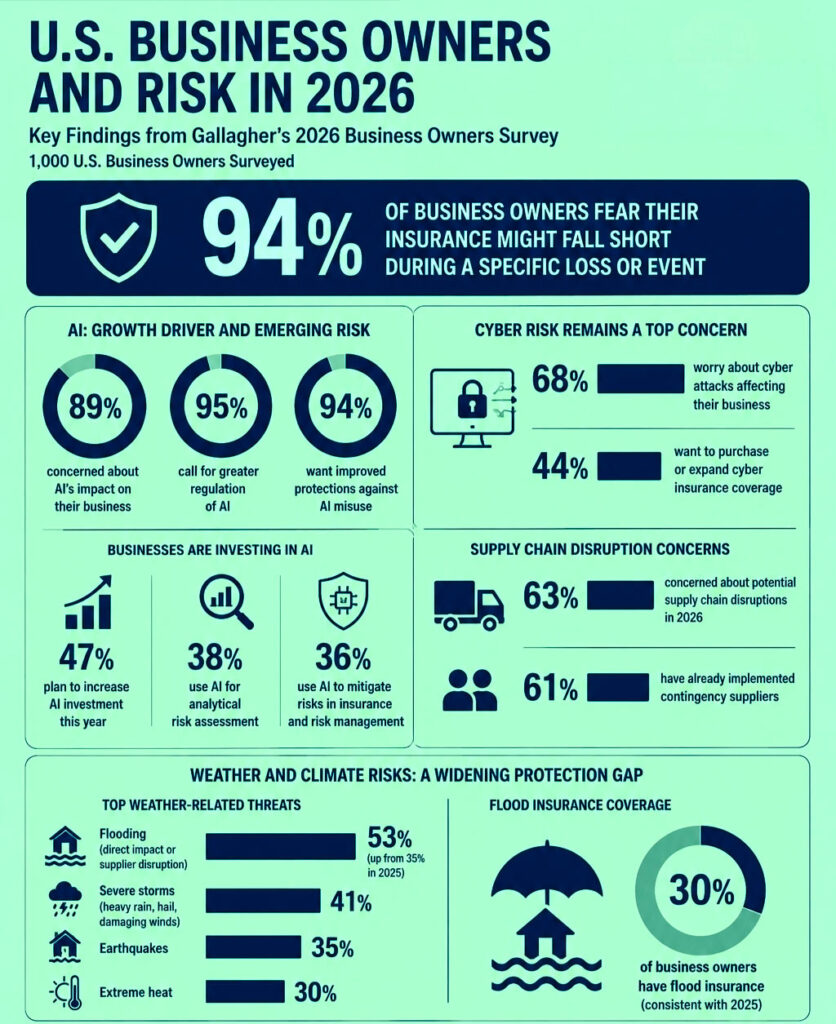
Even with those concerns, many companies still plan to increase AI investment. The survey found that 47% of business owners expect to spend more on AI use inside their businesses this year.
Companies are also using AI inside their risk management frameworks. Among respondents investing in AI, 38% use the technology for analytical risk assessment, while 36% use it to manage risks inside insurance and management programs.
Cyber risk remains a persistent concern for company leaders. Gallagher said the risk environment has moved from an emerging threat into a regular operational vulnerability.
The survey found that 68% of business owners worry cyberattacks will affect their companies, while 44% want to buy or expand cyber insurance coverage.
Supply chain volatility has also become a standard operating challenge. Business owners continue to face pressure from trade uncertainty, vendor disruption, shipping delays, input costs, and limited supplier visibility.
Gallagher found that 63% of business owners are concerned about potential supply chain disruptions in 2026. In response, 61% have already arranged contingency suppliers. That finding points to a wider shift toward redundancy, continuity planning, and more durable operating models.
What we’re seeing with business owners is a meaningful shift toward treating risk management as a business consideration that informs operations, investments and growth
J. Patrick Gallagher, Jr., chairman and CEO
“This mindset can help businesses build resilience in an increasingly complex risk environment.”
Extreme weather remains another major concern, though insurance coverage gaps persist. Gallagher found that 53% of respondents identify flooding as one of the top weather-related threats to their business, including direct damage and disruption affecting suppliers. That figure rose from 35% in 2025.
Only 30% of business owners said they have flood insurance, roughly unchanged from last year. The gap suggests many companies still carry material exposure to flood losses despite growing awareness of the risk.
Business owners also cited concern about severe storms bringing heavy rainfall, hail, or damaging winds. Gallagher found that 41% worry about those storm risks, while 35% cited earthquakes and 30% cited extreme heat.
Some companies have started investing in physical resilience. The survey found that 27% of business owners have already upgraded facilities with weather-resistant materials or plan to do so after a weather-related business claim.
According to Beinsure analysts, the Gallagher survey shows how small and mid-sized companies increasingly treat insurance as one part of a broader risk strategy.
AI, cyber, weather, and supply chain risks now affect revenue continuity, customer service, financing, and growth plans. The coverage gap remains the weak point, especially where owners understand the exposure but have not yet bought protection or funded mitigation.