- UK M&A activity by sector in 2026
- Financial services M&A reaches £35.6 bn
- Technology M&A grows as AI changes software valuations
- Healthcare acquisitions increase 460% to £13 bn
- Consumer markets lead deal value with £39.2 bn
- Industrials and energy attract strategic investment
- Investors concentrate capital in fewer acquisitions
- Execution certainty becomes a factor in M&A valuations
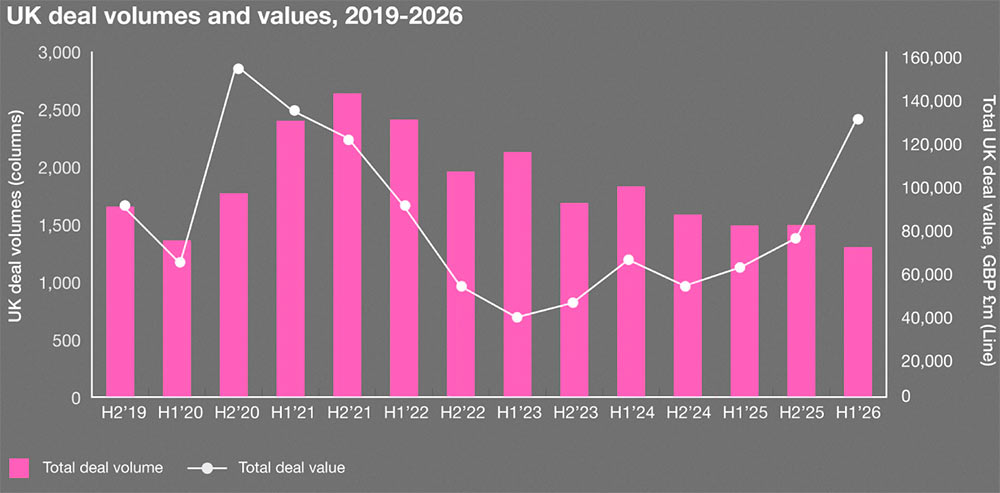
UK mergers and acquisitions reached £134.7 bn in the first half of 2026, up 125% from £60 bn a year earlier, despite a 12.6% decline in transaction volumes to 1,302, according to PwC’s UK M&A analysis.
Deal value almost returned to levels recorded in the second half of 2020, while transaction numbers continued their decline from the peak reached in the second half of 2021.
The ten largest transactions accounted for almost two-thirds of total UK deal value, indicating that investment growth was concentrated in a relatively small number of acquisitions rather than a broad recovery in activity.
Key highlights
- UK M&A deal value more than doubled to £134.7 bn in H1 2026, while transaction volumes declined 12.6% to 1,302. The ten largest deals accounted for almost two-thirds of total value.
- Financial services M&A reached £35.6 bn, driven by acquisitions involving Zurich, Beazley, Schroders and NatWest. Consumer markets led overall deal value at £39.2 bn.
- PwC reports stronger competition for strategically differentiated assets, with AI exposure, sustainable earnings and execution certainty increasingly influencing acquisition valuations.
PwC describes this divergence as a K-shaped market, where companies with established competitive advantages attract substantial capital while other businesses face weaker buyer demand. The pattern is evident internationally but more pronounced in the UK.
UK M&A activity by sector in 2026
Consumer markets recorded the highest transaction value at £39.2 bn, an increase of 486% year over year, although deal volumes fell 21% to 248 (see Global Insurance M&A report).
Financial services, including real estate, attracted £35.6 bn, up 115%, while the number of transactions declined 26% to 205. Industrials and services generated £19 bn in deal value, representing 38% growth, across 382 transactions, down 4%.
Technology, media and telecommunications (TMT) recorded £14.8 bn, an increase of 43%. Transaction volumes rose 5% to 320, making it the only sector in PwC’s breakdown to report growth in deal numbers.
Healthcare M&A increased 460% to £13 bn, despite an 11% decline in volumes to 86 transactions. Energy, utilities and resources also reached £13 bn, up 36%, while volumes contracted 32% to 58 deals.
Financial services, technology and healthcare accounted for substantial investment in assets linked to AI, digital infrastructure, specialist capabilities and intellectual property.
UK deals value by sector, value and volume
| Sector | H1 2026 Value £bn | Year-on-year Change | H1 2026 Volume | Year-on-year Change |
| Consumer Markets | £39.2 | 486% | 248 | -21% |
| Financial Services (inc. Real Estate) | £35.6 | 115% | 205 | -26% |
| Industrials & Services | £19.0 | 38% | 382 | -4% |
| TMT | £14.8 | 43% | 320 | +5% |
| Health Industries | £13.0 | 460% | 86 | -11% |
| Energy, Utilities & Resources | £13.0 | 36% | 58 | -32% |
| Total Deals | £134.7 | +125% | 1,302 | -12.6% |
Financial services M&A reaches £35.6 bn

Financial services represented 26% of total UK transaction value in H1 2026, increasing from £16.5 bn to £35.6 bn.
PwC attributes much of the activity to consolidation and acquisitions intended to modernize technology, improve capital efficiency and strengthen competitive positions.
Nuveen’s £9.6 bn acquisition of Schroders and EQT’s £2.8 bn acquisition of Coller Capital demonstrate continued consolidation across asset management.
In insurance, Zurich Insurance’s £8.1 bn acquisition of Beazley was among the sector’s largest transactions (see M&A in the Global Insurance Industry: 5 Growth Factors).
NatWest’s £2.7 bn acquisition of Evelyn Partners expanded its UK wealth management and advisory operations, while Standard Life’s £2 bn acquisition of Aegon UK increased its scale in long-term savings and insurance.
| Acquirer | Target | Deal value | Sector |
|---|---|---|---|
| Nuveen | Schroders | £9.6 bn | Asset management |
| Zurich Insurance | Beazley | £8.1 bn | Insurance |
| EQT | Coller Capital | £2.8 bn | Asset management |
| NatWest | Evelyn Partners | £2.7 bn | Wealth management |
| Standard Life | Aegon UK | £2.0 bn | Insurance and savings |
PwC expects financial services transactions to remain active as artificial intelligence, tokenization and digital infrastructure change operating models.
Banks, insurers and asset managers are increasingly assessing whether to develop technology and specialist capabilities internally or acquire businesses that already possess them.
Acquisitions can provide access to proprietary data, software, distribution channels and expertise that would otherwise require substantial investment and development time.
Technology M&A grows as AI changes software valuations
UK TMT deal value increased 43% to £14.8 bn, compared with £10.3 bn in H1 2025, accounting for 11% of total transaction value. Investment remained focused on AI-enabled software, digital infrastructure, data centers and data platforms.
PwC’s Global Data Centre Outlook 2026-2050 estimates that cumulative global investment in data centers could reach $31.6 tn by 2050. Electricity availability, government policy and data sovereignty requirements will influence investment locations, including opportunities in the UK.
Several major transactions demonstrate demand for technology and data-intensive businesses.
The sale of Sedex for more than £1 bn reflected investor interest in businesses combining technology, proprietary data and growth potential.
Nexfibre’s £2 bn acquisition of Substantial Group expanded its digital infrastructure operations, while Bullish’s £3.1 bn acquisition of Equiniti represented further investment in technology-enabled services.
Software valuations have become more difficult to assess as generative and agentic AI challenge established business models.
The market reassessment sometimes described as the “SaaSpocalypse” has increased scrutiny of software-as-a-service companies whose products could be replicated or replaced by AI applications.
Businesses with proprietary datasets, deeply integrated customer workflows and high switching costs generally provide stronger evidence of sustainable competitive advantages.
| Transaction | Deal value | Investment focus |
|---|---|---|
| Sale of Sedex | £1 bn | Technology, data and growth |
| Nexfibre acquisition of Substantial Group | £2 bn | Digital infrastructure |
| Bullish acquisition of Equiniti | £3.1 bn | Technology and data services |
Companies exposed to AI substitution face greater pressure to demonstrate that their products can retain customers and protect earnings.
Agentic AI could increase revenue and operating margins for some businesses while reducing demand for existing products and services elsewhere.
PwC warns that concentrated investment in AI-related assets may also push valuations ahead of underlying financial performance. Acquisition models therefore need to account for the possibility that AI adoption, revenue growth or profitability falls short of expectations.
Healthcare acquisitions increase 460% to £13 bn
Healthcare transaction value rose from £2.3 bn in H1 2025 to £13 bn in H1 2026, accounting for approximately 10% of UK M&A value.
The increase was driven by pharmaceutical acquisitions and demand for specialized research, innovative treatments and intellectual property.
GSK’s £8 bn acquisition of Nuvalent demonstrated the competition among pharmaceutical companies to secure new therapies and strengthen drug development pipelines.
Eli Lilly’s £5.1 bn acquisition of Centessa Pharmaceuticals similarly reflected demand for UK life sciences research and differentiated pharmaceutical assets.
PwC reports increasing specialization among healthcare investors, with life sciences private equity firms, healthcare-focused growth investors and global pharmaceutical companies concentrating on businesses with scalable operations and commercially valuable innovation.
Generalist investors have become more selective, particularly where valuations depend on scientific development, regulatory approvals and future commercialization.
Consumer markets lead deal value with £39.2 bn
Consumer markets accounted for 29% of total UK M&A value, reaching £39.2 bn in H1 2026. Two transactions accounted for most of the sector’s activity.
The £33 bn merger of Unilever’s food business with McCormick represented approximately 85% of consumer market deal value. Ingredion’s £2.7 bn acquisition of Tate & Lyle was another major transaction.
PwC attributes the increase primarily to corporate restructuring, shareholder activism and strategic portfolio disposals rather than a broad recovery in consumer sector investment.
Unilever’s decision to concentrate on health, beauty and hygiene illustrates the focus on simplifying business portfolios and reallocating capital.
Private equity investment in the wider consumer sector remains comparatively cautious, despite the increase in aggregate transaction value.
Industrials and energy attract strategic investment
Industrials and services recorded £19 bn in transaction value, with deal activity continuing despite weak UK economic growth and persistent operating cost pressures.
Energy, utilities and resources faced additional uncertainty from geopolitical developments, regulation and long-term government policy.
Strategic investors nevertheless continued to pursue infrastructure assets with established operating businesses and long-term investment requirements.
ENGIE’s £10.5 bn acquisition of UK Power Networks was a major example of capital directed toward UK energy infrastructure.
The transaction demonstrated continued demand for selected infrastructure businesses even as energy sector deal volumes declined 32%.
Investors concentrate capital in fewer acquisitions
PwC identifies capital availability as a supporting factor behind the increase in large transactions. Its Global Private Credit Survey 2026 found that four in five portfolio managers expected investment allocations to increase over the following 12 months.
That capital is being directed toward larger acquisitions, refinancing and alternative investment strategies rather than producing a corresponding increase in transaction numbers.
Corporate buyers also face pressure to modernize operations, particularly through technology acquisitions, but investment committees are demanding clearer evidence of expected financial returns.
PwC describes the resulting valuation advantage for selected businesses as a “Concentration Premium”.
The assessment focuses on four characteristics: strategic coherence, sustainable differentiation, executable value creation and fitness for the future.
| Valuation factor | What buyers assess |
|---|---|
| Strategic coherence | Alignment between the acquisition and the buyer’s business objectives |
| Sustainable differentiation | Competitive advantages that can be maintained over time |
| Executable value creation | Evidence that expected financial and operational improvements can be delivered |
| Fitness for the future | Ability to compete as technology, customer demand and market conditions change |
Businesses demonstrating these characteristics can attract stronger buyer competition and valuations above historical multiples.
Strategic coherence concerns how closely an acquisition fits the buyer’s objectives. Sustainable differentiation reflects the durability of a company’s competitive position, while executable value creation measures whether anticipated financial and operational benefits can realistically be delivered.
Fitness for the future considers exposure to technological change, shifting customer demand and competitive threats.
The approach is particularly relevant to acquisitions involving AI, where projected growth can depend on technology adoption and market expectations that remain uncertain.
Execution certainty becomes a factor in M&A valuations
PwC reports that buyers are placing greater emphasis on transaction preparation and certainty of completion as competition intensifies for selected assets.
The ability to demonstrate financing capacity, a credible integration plan and achievable operational improvements can influence acquisition decisions alongside the purchase price.
Generalist investors face increasing pressure to develop specialist expertise, while corporate buyers are strengthening internal M&A capabilities to identify and integrate acquisition targets.
For sellers, preparation and a defensible business strategy can improve buyer confidence and support valuations. Businesses without clear differentiation may face longer sale processes and weaker demand.
Concentration also increases investment risk. When substantial capital targets the same technologies or growth sectors, acquisition prices can become dependent on optimistic earnings assumptions.
PwC therefore emphasizes the need to distinguish businesses with demonstrable competitive advantages from those benefiting primarily from investor enthusiasm.
The ten largest UK transactions accounted for almost two-thirds of the £134.7 bn deployed in H1 2026, spanning consumer markets, financial services, industrials and healthcare. The figures show that acquisition capital remains available, but is increasingly concentrated in businesses with clear strategic value and credible financial returns.
………………
AUTHORS: Tetiana Mykhailova – Senior Analyst & CFO of Beinsure, Commercial Director of Finance Media