The insurance industry faces major claims for vessels damaged during the Iran war, according to Allianz SE. The company said in its annual safety and shipping review that it has already received claims linked to the conflict, including cases that could result in total losses, according to Beinsure.
Allianz did not disclose the potential claims value. The report estimated that vessels and cargo worth a combined $125 bn were trapped in the Persian Gulf as of June 15.
War-risk insurance premiums rose sharply after the conflict escalated. Some vessels faced costs of more than $1 mn per voyage to enter or leave the Strait of Hormuz. Those higher premiums give insurers extra revenue, yet repeated attacks can quickly turn that pricing into large claims exposure.
During the early stages of the war, attacks on ships occurred almost daily. The affected vessels included container ships, bulk carriers and oil tankers hit by drones and missiles.
Shipping incidents in focus: Total losses by year
Regis Broudin, global head of marine claims at Allianz Commercial, said loss of life and property damage remain the main causes of claims so far. He said the damage includes both vessels and cargo.
Marine insurance exposure has increased as geopolitical risk becomes a larger driver of shipping losses. According to Beinsure, the Iran conflict adds pressure to a market already dealing with higher repair costs, machinery claims inflation and war-risk pricing volatility.
The shipping industry still recorded safety improvements during the past year. Reported incidents involving vessels above 100GT fell by about 16%, from 3,353 in 2024 to 2,818 in 2025.
The East Mediterranean and Black Sea region recorded the highest number of reported incidents, with 622 cases. The British Isles followed with 619 incidents and remained the region with the highest incident count over the past decade.
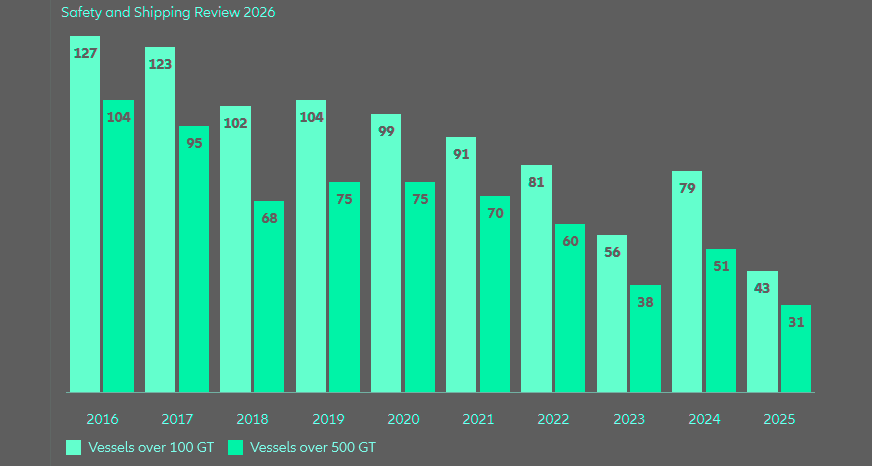
Machinery damage or failure remained the main cause of shipping incidents worldwide. It accounted for 1,505 cases, more than half of all reported incidents in 2025.
Vessel collisions ranked second with 260 incidents. Fire and explosion followed with 218 cases and remained a major concern for shipowners, operators and marine insurers.
Machinery-related losses matter because repair cost inflation has not returned to pre-Covid-19 levels. Repair expenses continued rising, and the Middle East conflict could add more pressure through supply chain disruption, longer transit routes and higher demand for specialist repairs.
Top causes of shipping incidents / casualties
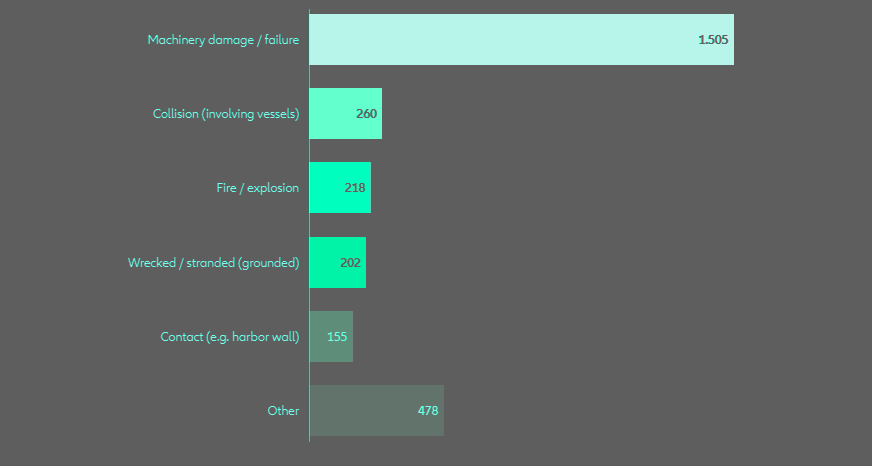
Allianz said more than 900 total losses involving vessels above 100GT were reported over the past decade. The total reached 905 vessels.
Between 2016 and the end of 2020, the industry recorded 555 total losses, equal to an average of 111 per year. Between 2021 and the end of 2025, the number declined to 350, or an average of 70 per year.
That reduction marks a 37% decline between the two five-year periods. Allianz linked the improvement to stronger safety regulation, better ship design, new technology and stronger risk management.
For 2025, 43 total losses have been reported so far. More than 30 of those vessels were above 500GT.
The South China, Indochina, Indonesia and the Philippines region remained the main global loss hotspot over both the past year and the past decade. The region recorded 255 losses over 10 years.
Heavy import and export flows through the region create dense shipping traffic. That traffic volume continues to drive high incident numbers.
The long-term safety record has improved, yet loss spikes still occur. Allianz said political risk and conflict now represent a rising source of maritime loss as geopolitical tensions intensify.
The report said the industry appears more exposed to political and conflict-related risks than at any point in recent decades. For marine insurers, that means war-risk coverage, cargo accumulation and vessel routing decisions now carry greater claims significance than they did in calmer trading conditions.