US stock index futures were mixed on October 15, 2026, as concerns about persistent inflation and the financing of artificial intelligence infrastructure continued to pressure technology shares following Wall Street’s sharpest decline since July.
At 4:04 a.m. ET, Nasdaq 100 futures were down 380.25 points, or 1.26%, while S&P 500 futures declined 27.5 points, or 0.35%. Dow Jones futures advanced 202 points, equivalent to 0.39%.
- Nasdaq 100 futures declined 1.26% and S&P 500 futures fell 0.35% on October 15, while Dow futures gained 0.39% as investors assessed inflation and AI financing risks.
- US annual inflation accelerated to 3.7% in September, above the 3.6% forecast, increasing expectations of further Federal Reserve interest rate hikes.
- Third-quarter earnings showed mixed results across major banks, while BlackRock reported $205 bn in net inflows and assets under management of $15.49 trillion.
The divergence followed broad market selloff, when the S&P 500 lost 1.11% to close at 7,718.94 and the Nasdaq Composite dropped 1.88% to 26,692.87. The Dow Jones Industrial Average declined 0.09% to 51,621.48, while the Russell 2000 fell 1.9% to 2,729.53.
Technology shares accounted for much of the market’s weakness as investors reassessed the financial sustainability of large-scale AI infrastructure spending under higher borrowing costs.
Despite the correction, the S&P 500 remained 12.8% higher year-to-date, while the Nasdaq had gained 14.8%.
US inflation accelerates to 3.7%, increasing Fed rate concerns
The immediate pressure on equities followed September’s Consumer Price Index report, released on October 14, which showed annual US inflation accelerating to 3.7% from 3.4% in August.
The reading exceeded economists’ consensus forecast of 3.6%, strengthening expectations that the Federal Reserve could raise interest rates again before the end of 2026.
Consumer prices increased 0.6% month over month, compared with a 0.4% rise in August. Gasoline prices climbed 9.1% during September, accounting for more than half of the monthly increase in the headline index.
The broader energy index rose 5.2% during the month and 20.4% from a year earlier, reflecting the effects of elevated fuel prices and continuing geopolitical tensions in the Middle East.
Core inflation, which excludes food and energy, reached 2.6% annually, above the 2.5% consensus forecast and up from 2.4% in August. Monthly core inflation remained at 0.3%, exceeding expectations of 0.2%.
The increase in underlying inflation suggested that price pressures were extending beyond energy costs.
Following the report, Citigroup revised its monetary policy outlook and forecast a 25-basis-point Federal Reserve rate increase in December, abandoning its previous expectation that rates would remain unchanged for the rest of 2026.
In early trading on October 15, futures markets implied a 27% probability of an October rate increase and a 67% probability of a 25-basis-point increase in December, according to CME Group data.
Higher interest rates present additional risks for businesses dependent on borrowing to finance investment, particularly companies expanding AI computing capacity and data center infrastructure.
AI stocks extend losses as financing costs rise
Technology shares remained under pressure on October 15 after substantial declines in AI infrastructure companies during the previous session.
CoreWeave fell another 4.5% in premarket trading after losing approximately 15% on Wednesday. Oracle declined 2%, extending its previous session’s nearly 9% loss.
Semiconductor companies also weakened. Nvidia fell 1.3% in premarket trading, while Micron Technology declined 4% and Advanced Micro Devices lost 1.9%.
Selloff erased approximately $80 bn in combined market value across several AI-related companies.
Investors are increasingly distinguishing between large technology companies capable of financing AI capital expenditure through operating cash flow and businesses more dependent on debt or external financing.
Higher borrowing costs have raised concerns about the profitability of data centers, AI computing infrastructure and the financial commitments supporting their expansion.
Taiwan Semiconductor Manufacturing Company added to the cautious outlook on October 15, warning about macroeconomic uncertainty in 2027 despite reporting its sixth consecutive record quarterly profit.
AI developer Anthropic provided a contrasting signal after telling prospective investors on October 14 that third-quarter revenue had increased 45% from the previous quarter to $16.8 bn. According to people attending the meeting, the company also reported profitability on an adjusted basis.
The disclosures provided further evidence of demand for AI services, although investors remain focused on whether rapid revenue growth can support the industry’s substantial infrastructure spending.
Bank earnings show mixed performance
Third-quarter results from major US financial institutions provided a second source of market volatility, with stronger lending and wealth management revenue offset by weaker fixed-income trading and higher expenses.
JPMorgan Chase and Goldman Sachs reported pressure in bond trading, reflecting the effects of interest rate volatility and reduced activity in some fixed-income markets.
JPMorgan’s fixed-income trading revenue declined 4% year over year, while Goldman Sachs reported broadly flat performance in that business. Equities trading remained stronger, increasing 49% at JPMorgan and 72% at Goldman Sachs.
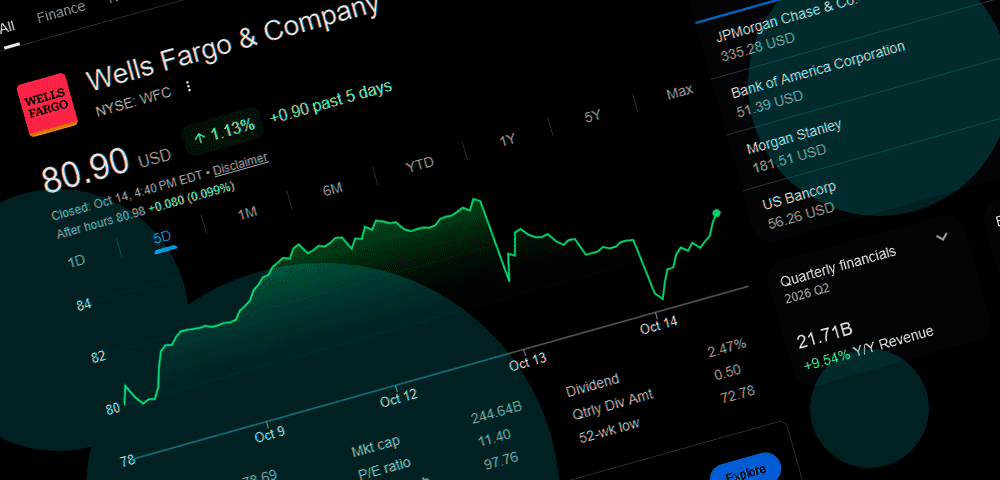
Wells Fargo reported a 6% increase in third-quarter net income to $5.95 bn, with diluted earnings reaching $1.87 per share, above the $1.85 consensus estimate. Revenue increased 2% to $21.87 bn but missed expectations of $22.31 bn. Net interest income rose approximately 5% to $12.52 bn, below the $12.63 bn forecast.
Average loans and deposits each increased 11% year over year, while the bank’s efficiency ratio improved to 63% from 65%. Return on tangible common equity reached 16.3%, approaching management’s medium-term target of 17% to 18%.
JPMorgan Chase reported third-quarter 2026 net income of $15.3 bn, an increase of 6% from a year earlier, as stronger investment banking activity, equities trading and consumer lending supported revenue growth across its main businesses.
Diluted earnings per share increased 10% to $5.57, compared with $5.07 in the third quarter of 2025. Reported revenue rose 8% to $50.2 bn, while revenue on a managed basis reached $50.9 bn, also up 8%.
The results included $658 mn in investment securities losses, equivalent to $498 mn after tax. Excluding this item, net income was $15.8 bn, diluted EPS reached $5.75 and return on tangible common equity (ROTCE) was 21%, compared with the reported 20%.
Investment banking fees rose 14% to $3 bn, primarily reflecting stronger advisory activity. JPMorgan retained its leading position in global investment banking fees, with a 9.2% market share for the year through September.
Citigroup delivered stronger results, reporting third-quarter net income of approximately $5.25 bn and earnings of $2.85 per share.
Revenue increased 8% to $23.85 bn, exceeding analysts’ expectations of $23.72 bn and marking the bank’s strongest third-quarter revenue performance in a decade.
Services revenue increased 15% to $6.61 bn, while Markets revenue rose 6% to $6.11 bn. Fixed-income trading revenue advanced 4% to $4.39 bn, contrasting with weaker performance at several competitors.
Bank of America reported revenue of approximately $30 bn, up 3% year over year, but net income declined to $6.9 bn from $8.3 bn.
Earnings fell to $0.91 per share, reflecting a $1.2 bn regulatory settlement charge related to deficiencies in the bank’s anti-money laundering compliance systems.
Excluding the charge, adjusted earnings reached $1.08 per share, below analysts’ expectations of approximately $1.10.
Net interest income increased 8% to $16.4 bn, although fixed-income, currencies and commodities trading revenue declined 17%. The bank also disclosed $109 bn in unrealized losses on its securities portfolio, compared with $85 bn at the end of June.
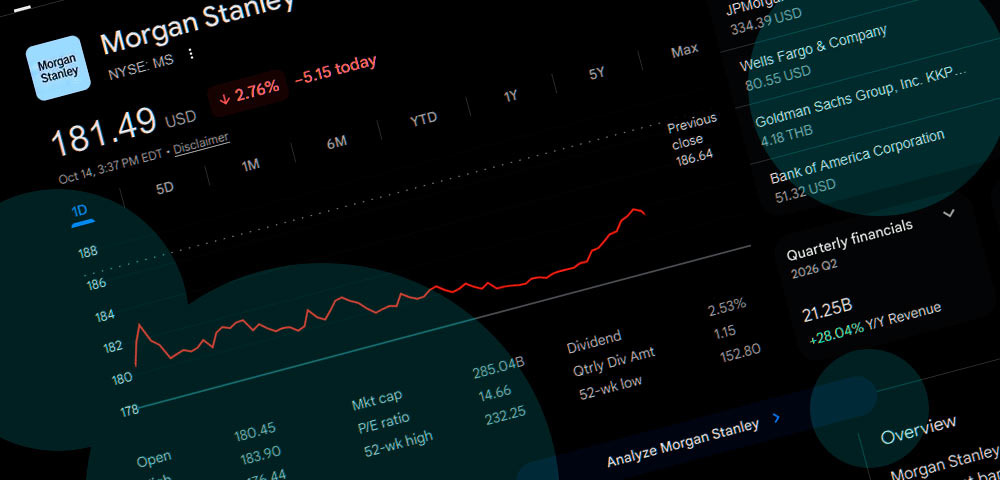
Morgan Stanley provided a stronger earnings result, reporting third-quarter revenue of approximately $20.3 bn, above the $19.9 bn consensus estimate.
Earnings reached $3.03 per share, exceeding expectations of $2.93, supported by investment banking activity, equities trading and wealth management.
BlackRock also exceeded Wall Street’s third-quarter expectations, reporting adjusted earnings of $15.93 per share, an increase of 38% year over year.
Revenue increased approximately 19% to $7.8 bn, supported by higher investment management fees, market appreciation and continued client inflows.
Assets under management reached $15.49 trillion, compared with $13.46 trillion a year earlier and $15.34 trillion at the end of the second quarter.
The asset manager attracted approximately $205 bn in net inflows during the quarter, including $134.5 bn into its iShares exchange-traded funds. Fixed-income products generated another $78.2 bn in inflows despite elevated bond yields and weaker bond prices.
BlackRock’s results demonstrated continued demand for investment products even as rising inflation and interest rates weighed on broader equity market sentiment.
Markets await further economic data
Investors will turn to additional US economic releases on October 15, including producer price inflation, September retail sales, initial unemployment claims and business activity surveys.
The figures will provide further evidence of how higher energy prices, borrowing costs and inflation are affecting consumer demand and corporate activity.
Federal Reserve policy expectations remain a principal influence on financial markets, particularly for technology companies dependent on continued investment in AI infrastructure.
For bank stocks, investors are assessing whether loan growth and higher net interest income can offset weaker bond trading, increased funding costs and regulatory expenses.
The immediate market outlook depends on whether incoming economic data reinforces expectations of additional Federal Reserve tightening and whether corporate earnings can support valuations after the recent equity selloff.